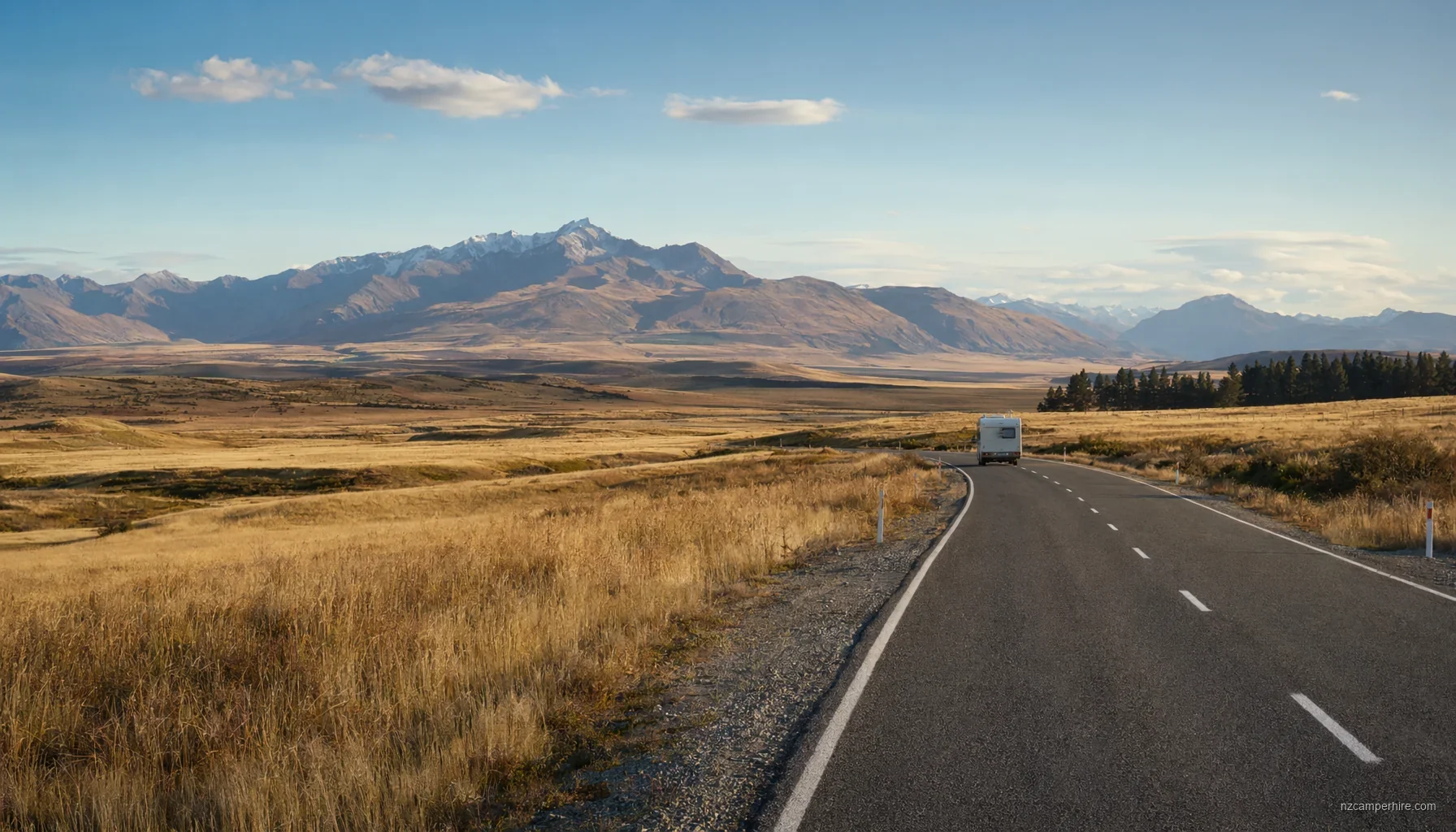
Campervan insurance options in New Zealand
Standard vs liability-reduction options, what's covered, what's not, and when to add extra cover.
- slow-morning
- wet-weather-plan
- bring-warm-layers
- family-friendly
At the depot in the morning, there is often a kettle somewhere, a clipboard on the counter, and the soft thud of bags being reshuffled while everyone remembers which side the indicator is on. Campervan insurance in New Zealand is usually simple once you know the vocabulary. The confusing bit is the excess, also called your liability, because that can be several thousand dollars unless you choose a reduction option.
Most problems come from exclusions, not from ordinary road accidents. Windscreens, tyres, overhead damage, underbody damage, wrong fuel and restricted roads are the lines to read twice before you leave Auckland, Christchurch or Queenstown.
Get the planning checklist — and reply with your dates if you'd like a planner to flag the campervan-insurance-specific gotchas for your route.
What the standard cover usually does
Most NZ motorhome rentals include basic vehicle cover. It normally protects the rental company’s vehicle and third-party property if you have an accident, subject to the excess written in your rental agreement. That excess is the amount you may have to pay before the cover responds.
The exact terms vary by operator and vehicle class. A 2-berth camper and a 6-berth motorhome can have different excess levels, bond holds and excluded items. Read the schedule, not just the sales page.
New Zealand drives on the left. Foreign licences in English are generally valid for up to 12 months. If your licence is not in English, bring an International Driving Permit or an approved translation. NZ Transport Agency, now Waka Kotahi NZTA, is the authority for licence rules.
Excess reduction: what you are really paying for
An excess-reduction option lowers the amount you are liable for after covered damage. It may also reduce the credit-card bond held at pick-up. This is why many first-time visitors add it, especially after a long-haul flight into Auckland or Christchurch.
Do not assume “zero excess” means every type of damage is included. Many agreements still exclude roof strikes, underbody damage, tyre sidewalls, windscreen chips, awning damage, lost keys, contaminated fuel and careless use. Some options include windscreen and tyre cover. Some do not.
For a South Island in 14 days route, the decision matters because you may drive SH73 over Arthur’s Pass at 920 m, SH6 down the West Coast, the Crown Range Road at 1,121 m, and SH94 to Milford Sound. These are sealed public roads, but the weather, gradients and tight car parks make small mistakes expensive.
The exclusions that catch visitors out
Insurance problems often start away from the open highway. Slow-speed damage is common in holiday parks, supermarket car parks and scenic pull-outs. A high roof and a rear overhang change how the vehicle behaves.
The little scrape you prevent in a supermarket car park can feel just as valuable as the big view you drove there for.
- Overhead damage: trees, motel balconies, low service-station canopies and drive-through lanes. Measure the vehicle height and tape it near the steering wheel.
- Underbody damage: steep driveways, road shoulders, rocks, ferry ramps and rough campsite tracks.
- Unsealed or restricted roads: many contracts limit where you can drive. Beaches, riverbeds, ski-field access roads and farm tracks are commonly excluded.
- Snow and ice: winter driving can require chains. SH94 to Milford Sound and the Crown Range can be controlled or closed after snow.
- Personal belongings: vehicle cover usually does not replace passports, cameras, phones or luggage. That is a travel-insurance issue.
If you are using the Queenstown region guide as part of a winter itinerary, pay close attention to road closures, chain requirements and car-park manoeuvring. Queenstown is beautiful to drive into, but tight with a long motorhome.
Bonds, credit cards and travel insurance
The bond is separate from the daily insurance option. It is usually a pre-authorisation or charge on a credit card at pick-up. Debit cards can be a problem, especially for larger vehicles, so check this before you land.
Travel insurance may cover your rental-vehicle excess, but it usually works as reimbursement. That means you may still have to pay the rental company first, then claim later with documents. Keep the rental agreement, damage report, repair invoice, police report if required, and card statement.
New Zealand’s ACC system helps with injury treatment after accidents in NZ, including visitors, but it is not a replacement for travel insurance. It does not cover lost luggage, itinerary disruption, repatriation, or most vehicle-damage costs.
When extra cover is worth considering
Extra cover is not automatically necessary for everyone. It is more attractive if you are new to left-side driving, collecting the vehicle straight after an overnight flight, travelling in winter, taking a larger motorhome, or spending time on narrow scenic roads.
Extra cover can feel like an annoying extra cost, but a high excess feels worse when a tired arrival day meets a narrow car park.
A 6-berth can be cheaper per person but harder to park in places such as central Queenstown, Akaroa, Rotorua lakefront areas and older holiday parks. A 2-berth or compact 4-berth is easier on the Crown Range and in supermarket car parks, but it may not suit families carrying winter gear.
Useful trip-planning links to pair with this guide are the South Island in 14 days route guide, the Queenstown region guide, the vehicle-size guide and the campervan cost guide. Insurance is one line in the budget, but it affects the whole risk picture.
Rules and practicalities are easier to remember when you've felt them — the cold of a wet boot at a freedom camp, the relief of an early ferry slot. This guide is written from those moments, not from a checklist.
Related reading
 ROUTE
ROUTE South Island in 14 days
Classic clockwise South Island loop — Kaikoura, Nelson, West Coast glaciers, Wanaka, Queenstown, Milford Sound, Tekapo, back to Christchurch.
See the route REGION
 Queenstown
Southern Lakes depot. Closest pickup for Milford Sound, Wanaka, Glenorchy, and the Southern Scenic Route.
See the region PRACTICAL GUIDE
 What a NZ campervan trip actually costs
Rental + fuel + ferry + sites + food + activities for 7/14/21-day trips at each tier.
Read the guideCampervan insurance options FAQ
Is campervan insurance compulsory in New Zealand?
Does travel insurance replace campervan excess reduction?
Am I covered if I drive on gravel roads?
What should I do after an accident or damage?
Can insurance be voided by normal tourist mistakes?
Have a planner answer this for your specific trip
Rules and practicalities depend on dates, party size, and route. Send us your outline and we'll come back with answers tailored to your trip.