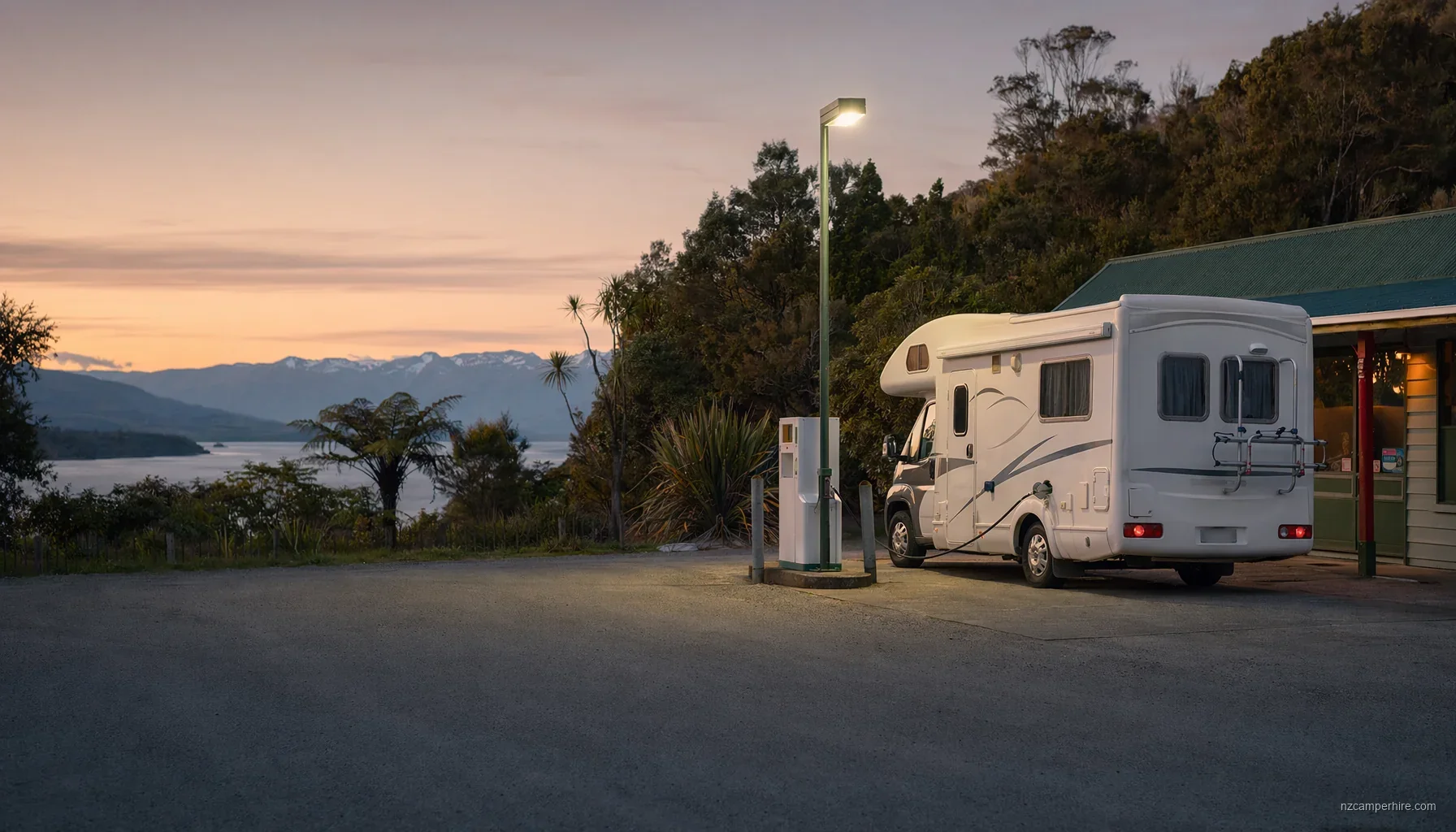
Realistic NZ motorhome fuel economy
L/100km by berth size, diesel RUC, total fuel cost for 14/21-day trips. Honest, granular how-to — written from on-the-ground knowledge, not ...
- logistics
- budget
New Zealand motorhome fuel economy is not one tidy number. A 2-berth diesel van on SH1 near Christchurch is one thing. A 6-berth climbing SH94 to Milford Sound in rain and headwind is another.
This guide sits under Fuel economy and prices in NZ and pairs with What a NZ campervan trip actually costs. It is especially useful on South Island in 14 days, North to South in 21 days, and February trips through Queenstown, Fiordland, and the West Coast.
Get the planning checklist that pairs this with the route-level gotchas for your trip, or reply with your dates if you'd like a planner to flag the fuel-specific traps on your week.
The litre-per-100 km numbers I would actually budget
Use these as planning ranges, not brochure promises. New Zealand drives on the left, roads are often narrow, and a lot of good routes are slower than they look on a map.
- Small 2-berth high-roof camper: about 9 to 11 L/100 km if driven gently.
- 2-berth with toilet and shower: about 10 to 12.5 L/100 km. More weight, more wind drag.
- 4-berth motorhome: about 12 to 14.5 L/100 km on mixed touring roads.
- 6-berth motorhome: about 14 to 17 L/100 km, and more if heavily loaded or pushed hard.
If you are coming from Australia, the USA, or Europe, do not compare this with motorway touring at home. NZ fuel burn comes from corners, braking, hills, and constant speed changes.
Why New Zealand burns more fuel than the map suggests
The South Island is the classic trap. SH6 down the West Coast, SH8 through the Mackenzie Country, SH73 over Arthur's Pass at 920 m, and SH94 into Milford Sound all cost more fuel than flat highway driving. The Crown Range between Wanaka and Queenstown reaches 1,121 m. Lindis Pass on SH8 reaches 965 m. Haast Pass is lower at 564 m, but it is still slow, winding driving.
On the Queenstown to Milford Sound drive, allow 287 km each way via Te Anau, around 4.5 to 5.5 hours one way in a motorhome before stops. A big vehicle will use noticeably more fuel on that day than it did between Christchurch and Lake Tekapo.
Wind matters too. Canterbury, Southland, and the Desert Road near Tongariro can make a tall motorhome feel like a sail. Slowing from 100 km/h to 85 or 90 km/h often saves fuel and feels safer.
Diesel RUC and pump stops without the rental-counter fog
Most larger NZ motorhomes are diesel. Diesel is usually priced differently at the pump because Road User Charges, called RUC, are handled separately. Rental operators deal with this in different ways. Some include RUC in the hire terms. Some charge a per-kilometre RUC amount when you return the vehicle. Check the wording before you model your trip cost.
For the official rule, see the NZTA / Waka Kotahi rule on road user charges. Do not rely on an old forum post, as RUC settings and rental policies can change.
Fuel is easy in cities and main towns: Auckland, Rotorua, Wellington, Picton, Christchurch, Queenstown, Wanaka, Te Anau, and Dunedin. It gets thinner on the West Coast, around Makarora, and between Te Anau and Milford Sound. Fill before remote legs. Do not start SH94 with a quarter tank.
Worked litres for 14 and 21 days
Here is the cleaner way to budget without inventing a dollar figure that will be wrong by next season. Estimate kilometres first. Then multiply by your vehicle's L/100 km. Then add RUC if it is charged separately.
South Island in 14 days
A normal loop or one-way route with Christchurch, Lake Tekapo, Mount Cook / Aoraki, Wanaka, Queenstown, Milford Sound, and the West Coast often lands around 2,200 to 2,800 km once supermarket runs and campsite detours are included.
- Small 2-berth: roughly 220 to 310 litres.
- 4-berth: roughly 290 to 405 litres.
- 6-berth: roughly 350 to 475 litres.
North to South in 21 days
Auckland to Rotorua, Tongariro, Wellington, the Cook Strait ferry, Picton, Kaikoura, Christchurch, the Southern Lakes, and Milford Sound can easily reach 3,200 to 4,000 km. The Wellington to Picton ferry is not a driving leg, but allow 3 hours 20 minutes crossing time, around 3.5 hours with loading. For ferry safety and operator requirements, check Maritime NZ and the ferry operator pages.
- Small 2-berth: roughly 320 to 440 litres.
- 4-berth: roughly 415 to 580 litres.
- 6-berth: roughly 510 to 680 litres.
Fallbacks if the fuel budget or vehicle size is wrong
If those litre totals feel high, change the route before you change the whole trip. Cutting one long out-and-back drive often does more than chasing a tiny difference in fuel economy.
- Base in Te Anau for Milford Sound, rather than doing a huge Queenstown return day.
- Choose a 2-berth or compact 4-berth if you are nervous about alpine roads and fuel burn.
- Use powered holiday parks in practical places, such as Creeksyde Queenstown, Hokitika Holiday Park, Oamaru Top 10, and North South Holiday Park in Christchurch, so you are not driving extra kilometres looking for facilities.
- Plan DOC nights where they fit the route, not as fuel-saving magic. Lake Pukaki, White Horse Hill, Mavora Lakes, and Cascade Creek are useful in the right itinerary. Check access and rules at doc.govt.nz.
- Read Driving in NZ on a foreign license and Driving on the left in NZ if this is your first motorhome trip here. Foreign licences in English are valid for up to 12 months. If your licence is not in English, bring an International Driving Permit or approved translation.

Rules and practicalities are easier to remember when you've felt them — the cold of a wet boot at a freedom camp, the relief of an early ferry slot. This guide is written from those moments, not from a checklist.
Related reading
 ROUTE
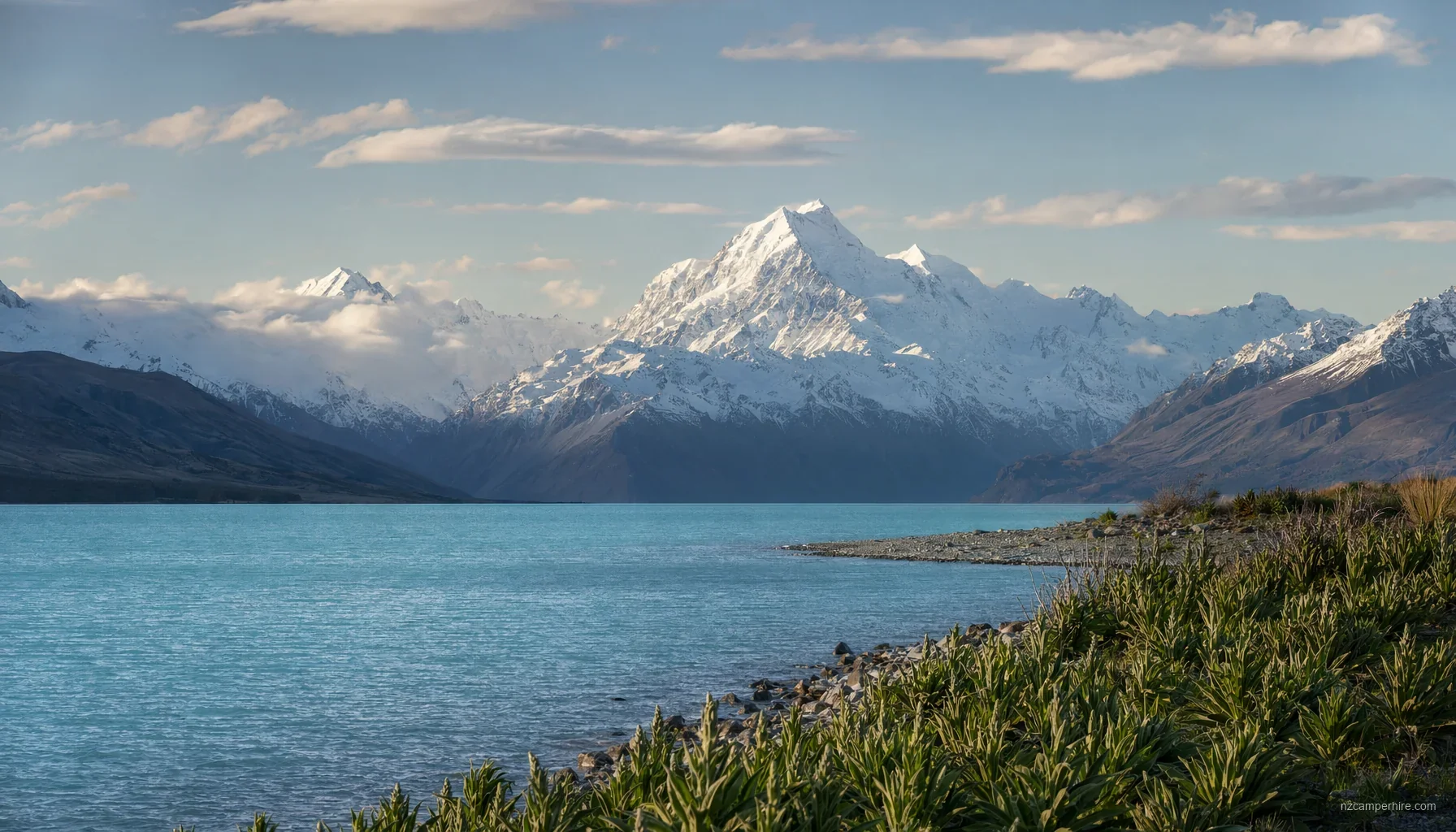
ROUTE South Island in 14 days
Classic clockwise South Island loop — Kaikoura, Nelson, West Coast glaciers, Wanaka, Queenstown, Milford Sound, Tekapo, back to Christchurch.
See the route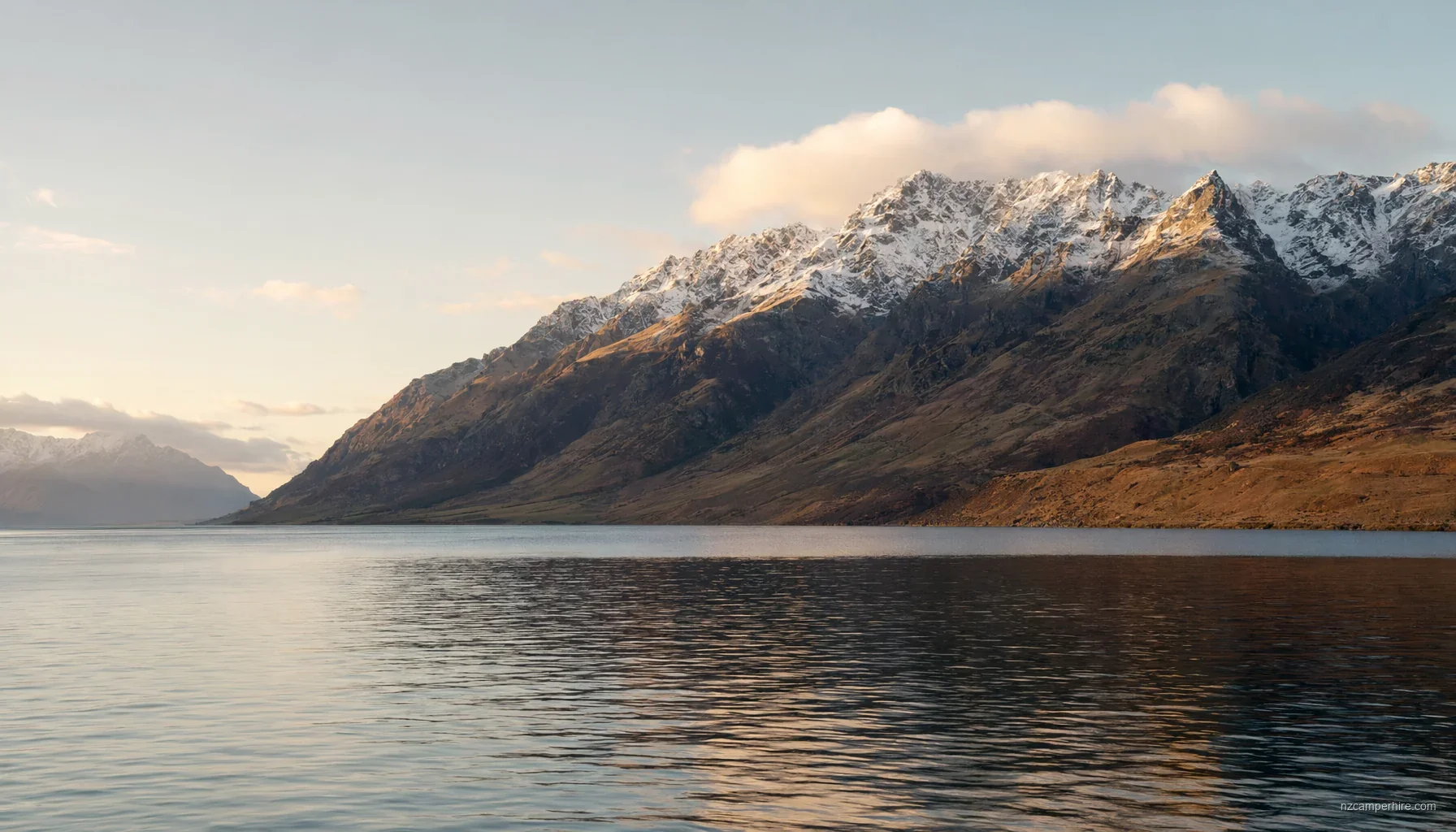 REGION
 Queenstown
Southern Lakes depot. Closest pickup for Milford Sound, Wanaka, Glenorchy, and the Southern Scenic Route.
See the region PRACTICAL GUIDE
 Best time of year for a NZ campervan trip
Month-by-month — weather, demand, school holidays, peak ferry windows.
Read the guideRealistic NZ motorhome fuel economy FAQ
What is good campervan fuel economy in NZ?
Are diesel motorhomes cheaper to run than petrol campervans?
How much fuel should I allow for a 14-day South Island trip?
Where should I be careful about fuel stops?
Have a planner answer this for your specific trip
Rules and practicalities depend on dates, party size, and route. Send us your outline and we'll come back with answers tailored to your trip.