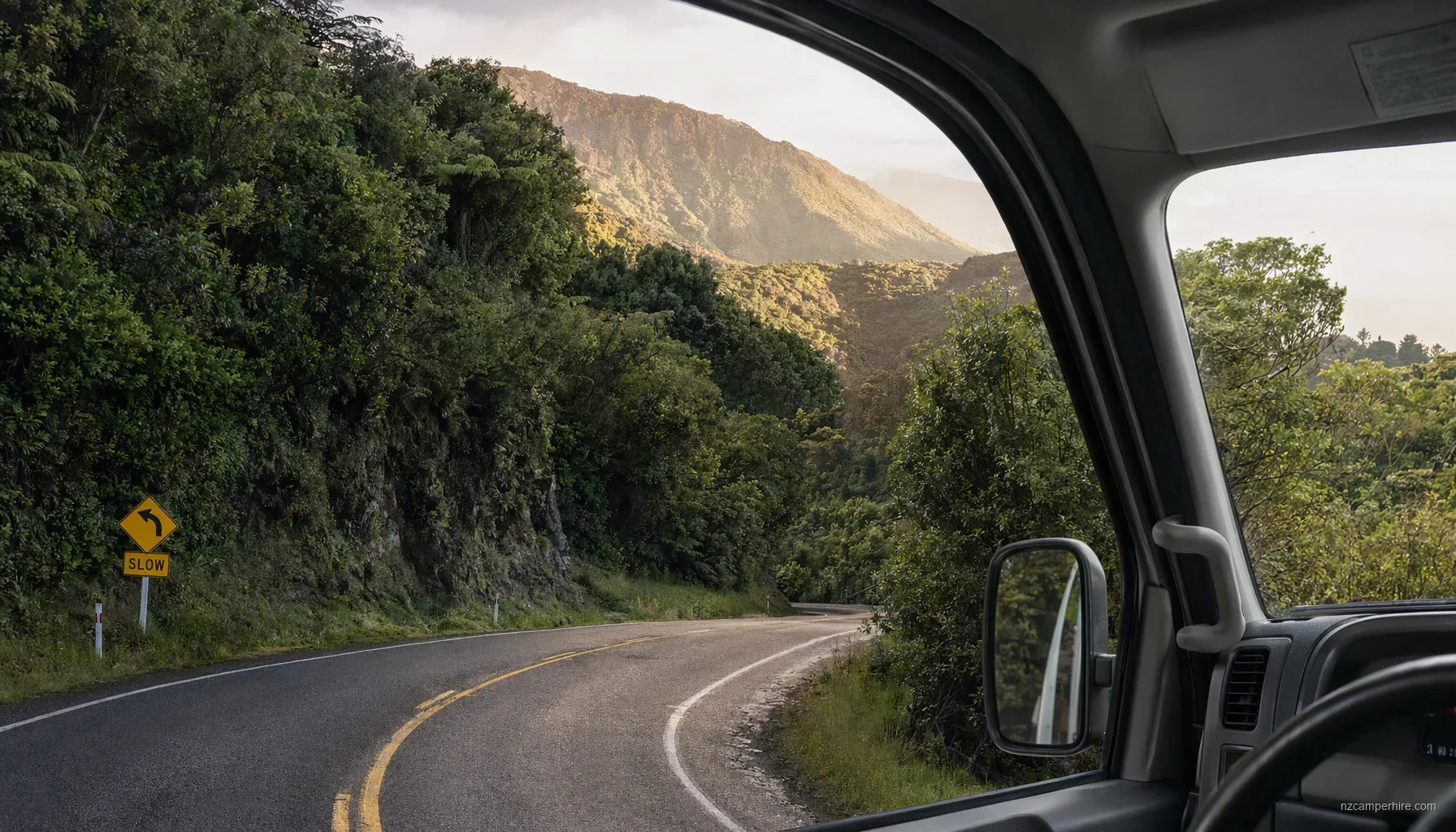
Driving on the Left in New Zealand by Motorhome
Roundabouts, give-way rules, narrow bridges, and the one-lane bridge etiquette.
- wet-weather-plan
- family-friendly
- solo-friendly
- busy-summer
- bring-warm-layers
There is a particular hush outside a rental depot just after breakfast: suitcases zipped, kettle packed away, and everyone quietly rehearsing which side of the road comes first.
New Zealand drives on the left. That sounds simple until you leave the rental depot in Auckland, Christchurch or Queenstown, meet your first roundabout, and realise the camper is wider than the car you drive at home.
The good news: NZ roads are well signed, speeds are lower in practice, and most visitors settle in after the first hour. The risky bits are predictable: turning across traffic, drifting right after a stop, narrow bridges, gravel shoulders, and mountain roads like SH94 to Milford Sound.
Get the planning checklist — and reply with your dates if you'd like a planner to flag the left-hand-driving-specific gotchas for your route.
Start slowly after pickup, especially in the cities
Your first 30 minutes matter. After pickup, take a quiet loop before aiming at SH1 or a supermarket car park. Sit in the lane closest to the left kerb. Your steering wheel is on the right, but the vehicle belongs on the left side of the road.
In a motorhome, the lane feels narrower because you are sitting near the centre line. Use your left mirror often. The left wheels can run close to kerbs, drainage channels and soft shoulders, especially around Auckland, Christchurch and smaller towns with angled parking.
- Keep the driver nearest the centre line.
- Turn wide, then check the rear swing before straightening.
- Use both mirrors before changing lanes. Blind spots are bigger in campers.
- Do not use a hand-held mobile phone while driving.
- All occupants must wear seatbelts while the vehicle is moving.
If you are starting a North Island in 10 days route from Auckland, the Auckland to Rotorua drive is about 230 km and usually 3 hours 15 minutes to 3 hours 45 minutes in a camper, not including food stops.
Roundabouts and give-way rules that catch visitors
At roundabouts, give way to traffic coming from your right. Enter only when the gap is safe. Indicate left as you exit if practical. If you are going more than halfway around, indicate right on entry, then left as you leave.
At intersections, the basic rules are plain once you slow down. Give way to vehicles on your right at uncontrolled crossroads. A vehicle turning gives way to traffic going straight through. At a T-intersection, the vehicle on the terminating road gives way. Pedestrians have priority on marked crossings.
Be extra careful after petrol stops, viewpoints and lunch breaks. That is when many international drivers pull out onto the wrong side from habit. Say out loud, “left lane”, before moving off. It sounds silly. It works.
You will know the new habit is settling in when the passenger stops whispering left lane and starts noticing the pies in the bakery window.
Painted lane arrows overrule assumptions. In towns like Rotorua and Queenstown, lane markings change quickly near supermarkets, lakefront roads and one-way streets. Choose your lane early and do not swing across late because the GPS spoke too slowly.
One-lane bridges, narrow shoulders and mountain roads
New Zealand still has many one-lane bridges. The sign usually shows two arrows. If the large white arrow points your way, you have priority. If the red arrow points your way, give way. If another vehicle is already on the bridge, wait even if you think you have priority.
Several scenic roads need more respect in a motorhome than they seem to need on a map. SH73 over Arthur's Pass reaches 920 m and has viaducts, steep grades and kea around the car parks. SH6 over Haast Pass is lower at 564 m but wet, shaded and winding. The Lindis Pass on SH8 reaches 965 m. The Crown Range Road reaches 1,121 m and is not a relaxed first-day drive in a large camper.
Queenstown to Milford Sound on SH94 is 287 km one way and normally 4 hours 30 minutes to 5 hours before photo stops, roadworks or the Homer Tunnel queue. Christchurch to Greymouth via Arthur's Pass is about 240 km and 3 hours 30 minutes to 4 hours. Use these real timings beside the South Island in 14 days route guide and the Queenstown region guide, not a perfect-weather car estimate.
Speed limits are the ceiling, not the target
Open-road limits are often 100 km/h, with 50 km/h in many towns and variable limits near schools or roadworks. A motorhome on SH6, SH73 or SH94 may be safest at 75 to 90 km/h through bends, rain and hill country. That is normal. The mistake is holding traffic for 20 minutes because you are embarrassed to pull over.
The tradeoff is simple: slower is safer on bends, but you need to pull over early so safe does not become a long queue behind you.
Use slow-vehicle bays. If a queue forms behind you, indicate left, pull fully off where it is safe, and let the locals through. Do not stop on yellow no-stopping lines, blind corners or narrow bridge approaches.
Allow more space than you would in a car. Campers are heavy, high and slower to stop. Wind matters too. Canterbury, the Mackenzie Country near Lake Tekapo, and exposed bridges can push a high-sided vehicle around. If the wheel needs constant correction, slow down and take a break.
For vehicle choice, the larger end of the rental market gives good living space for families but is less pleasant on tight passes and town parking. A vehicle-size guide is worth reading before you set an itinerary heavy on Queenstown, Wanaka, the West Coast or Milford Sound.
Licences, age rules and official places to check
Waka Kotahi, the NZ Transport Agency, sets the visitor licence rules. In general, you can drive in New Zealand for up to 12 months on a current overseas licence if it is in English. If it is not in English, carry an International Driving Permit or an approved translation. Check the official wording at nzta.govt.nz.
Minimum hire age varies by operator and vehicle class, commonly from 18 to 25. Younger drivers may have fewer vehicle options and extra conditions. Your licence also needs to match the vehicle class, although most standard rental motorhomes can be driven on a normal car licence.
Tourism New Zealand also publishes visitor driving advice at newzealand.com. Use official road advice first, then layer in practical planning pages such as the Cook Strait ferry guide, the freedom camping guide and the supermarket stops guide when you build the route.
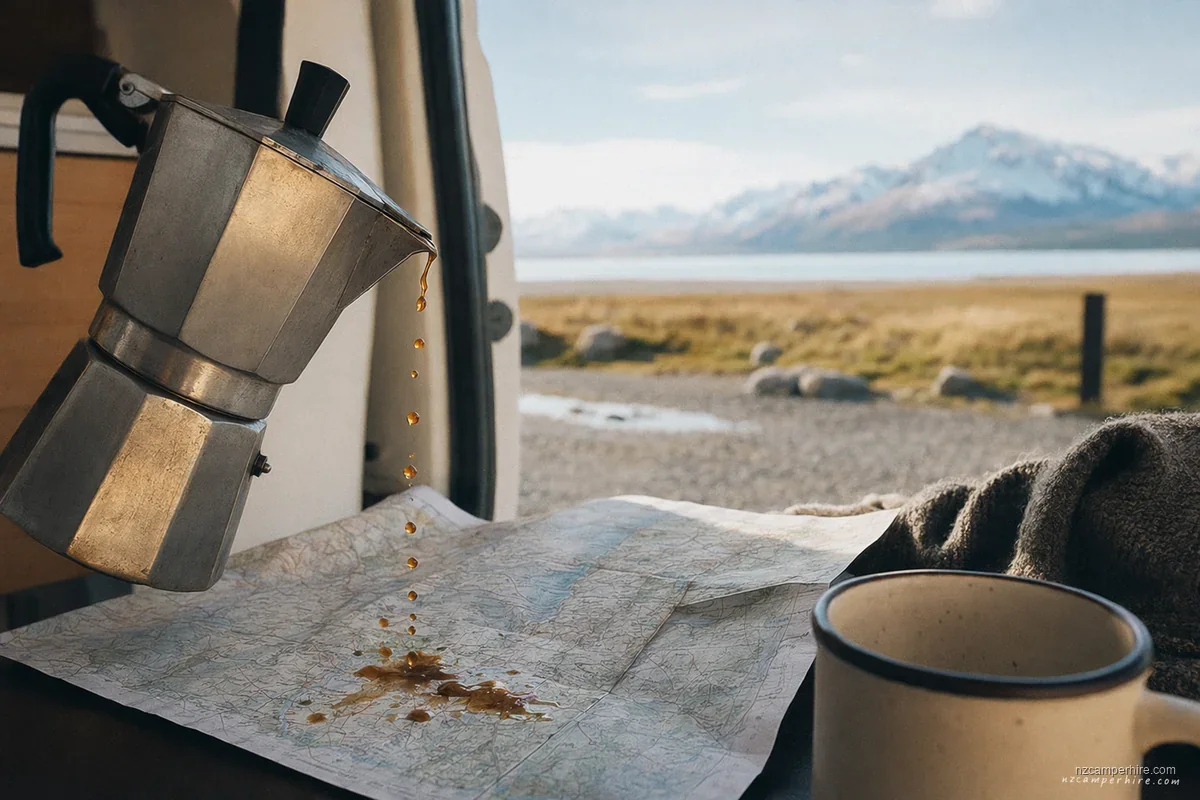
Rules and practicalities are easier to remember when you've felt them — the cold of a wet boot at a freedom camp, the relief of an early ferry slot. This guide is written from those moments, not from a checklist.
Related reading
 ROUTE
ROUTE North Island in 7 days
Faster North Island route — Auckland to Wellington with Rotorua and Tongariro stops.
See the route REGION
 Auckland
Largest North Island depot. Start of every classic North Island loop (Bay of Islands, Coromandel, Rotorua, Hobbiton, Tongariro).
See the region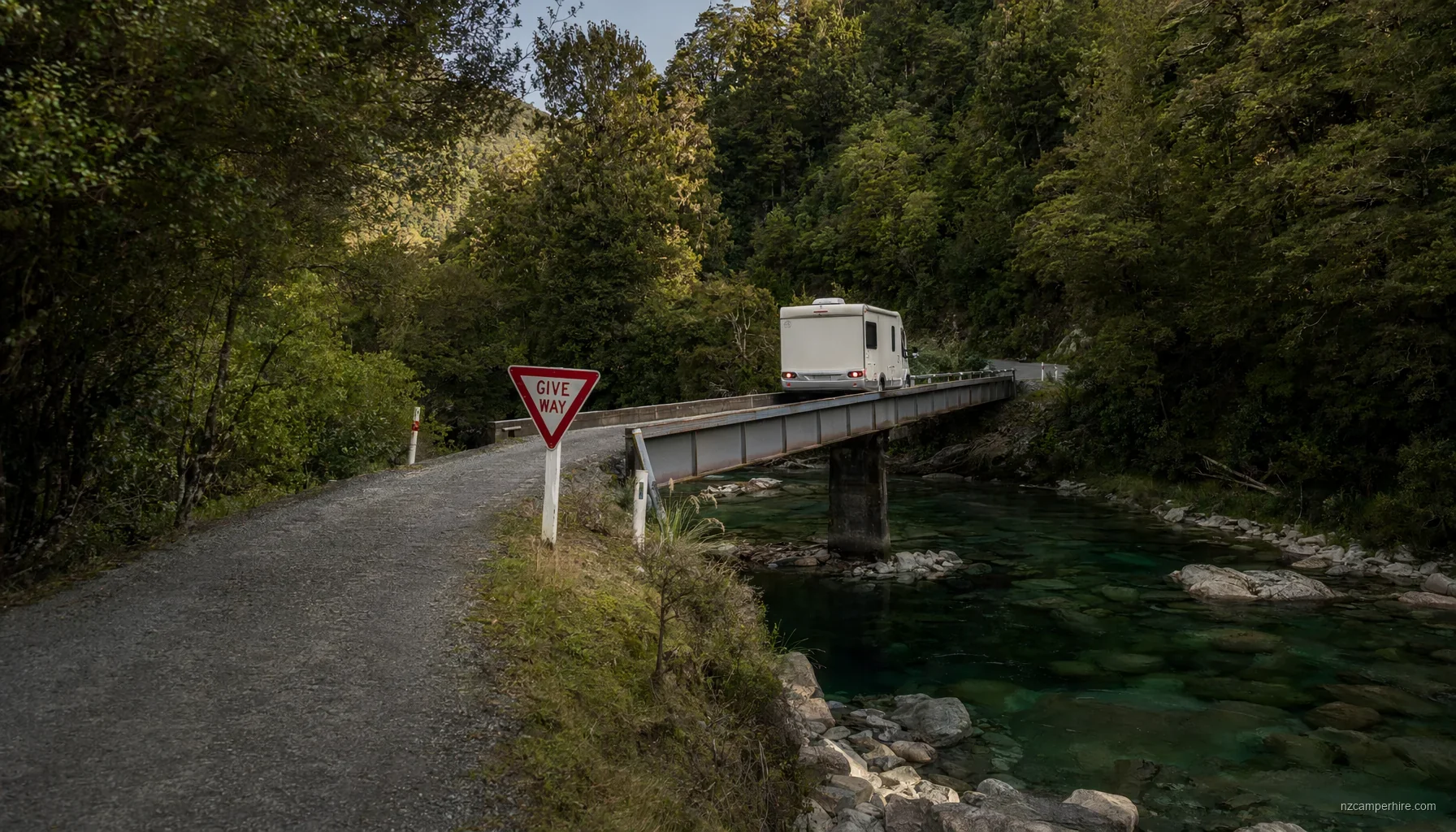 PRACTICAL GUIDE
 First time driving a motorhome
Height awareness, swing on turns, parking, reversing — short briefing before pickup.
Read the guideDriving on the left in NZ FAQ
Is it hard to drive on the left in New Zealand?
Who gives way at a New Zealand one-lane bridge?
Can I drive a motorhome in NZ with my overseas licence?
Are NZ road distances slower than they look on the map?
Is it legal to stop at a rest area if I feel too tired to drive?
Have a planner answer this for your specific trip
Rules and practicalities depend on dates, party size, and route. Send us your outline and we'll come back with answers tailored to your trip.