Winter Campervan Travel in New Zealand
Snow chains, lower rates, heater realities — winter campervan travel in NZ.
- wet-weather-plan
- quiet-roads
- bring-warm-layers
- book-ahead
- ferry-stage
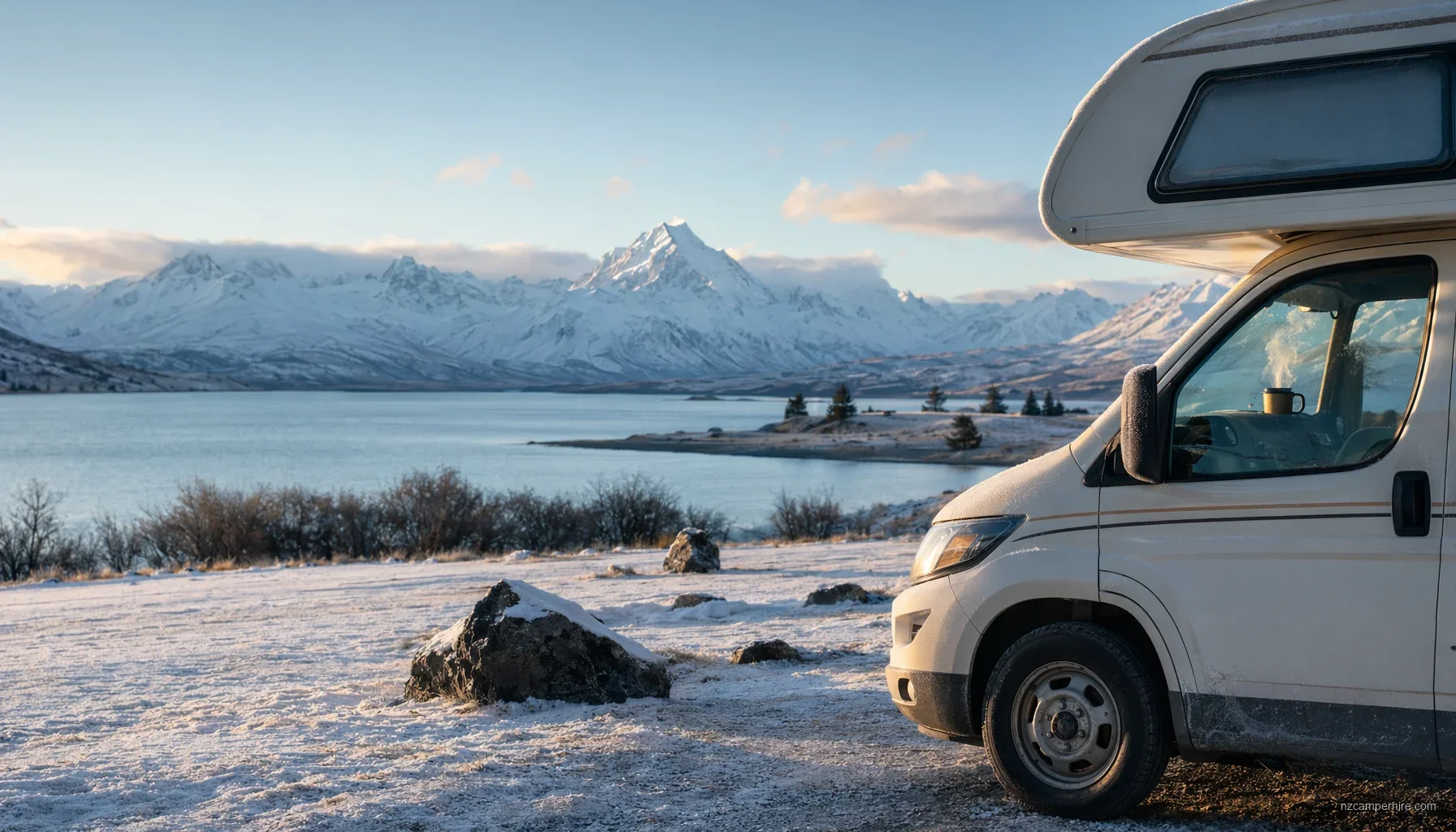
On a clear winter morning, a campervan can feel like a small warm cabin while the valley outside is all pale grass, breath-clouds, and tyre crunch. The kettle becomes part of the route planning, just as much as the map.
Winter is a good time to travel New Zealand by campervan if you plan like a driver, not like a brochure. June, July, and August bring lower demand, quiet roads, short daylight, wet West Coast days, and real snow risk on alpine routes.
New Zealand drives on the left. Highways are often two-lane roads with no median barrier. In winter, SH73 over Arthur's Pass, SH8 over the Lindis Pass, SH94 to Milford Sound, and the Crown Range road can change from easy to serious within an hour.
Get the planning checklist — and reply with your dates if you'd like a planner to flag the winter-specific gotchas for your route.
What winter changes for a motorhome day
Winter travel is less about freezing all day and more about timing. Sunrise sits around 7.30 am to 8.15 am in much of the South Island. Sunset can be before 5.15 pm. That leaves a short driving window if you also want walks, food stops, dump stations, and a safe arrival before dark.
The best winter mornings are the unhurried ones, with the kettle ticking softly while frost lifts off the grass before the first careful kilometre.
Plan 180 to 260 km as a solid winter day, not 400 km. Christchurch to Lake Tekapo is 225 km and about 3 hours 15 minutes in a motorhome with a supermarket stop. Queenstown to Milford Sound is 287 km one way and often 4.5 to 5.5 hours before photo stops, ice warnings, or avalanche control delays.
Rain is normal on the West Coast. Frost is normal in Central Otago, the Mackenzie Country, and Tongariro. Black ice is hardest to see early morning and after sunset, especially in shaded valleys.
Snow chains, passes, and roads that need respect
Ask the rental operator how snow chains work before you leave the depot. Some vehicles carry them. Some require you to add them. Some rental agreements restrict alpine roads during snow or ice. Do not learn chain fitting in sleet at 1,000 metres.
- Arthur's Pass, SH73, 920 m: Christchurch to the West Coast. Watch for ice near Porters Pass, Castle Hill, and Otira.
- Lindis Pass, SH8, 965 m: Tekapo or Twizel to Wanaka and Queenstown. Open country, wind, and fast temperature drops.
- Crown Range, 1,121 m: Queenstown to Wanaka. Steep, scenic, and not friendly to large motorhomes in poor conditions. SH6 via Cromwell is longer but often easier.
- Haast Pass, SH6, 564 m: Lower altitude, but wet, shaded, and prone to slips after heavy rain.
- Milford Road, SH94: Alpine conditions, avalanche control, no fuel at Milford Sound, and long stretches without mobile coverage.
Check NZ Transport Agency Waka Kotahi traffic updates before high passes: https://www.nzta.govt.nz/traffic-and-travel-information/. If the sign says chains required, fit them. If the road is closed, wait. There is no clever shortcut around most South Island passes.
Heating, batteries, condensation, and wet gear
Most rental motorhomes have a house battery for lights, water pump, fridge controls, and USB charging. Heating varies by vehicle. Some heaters run on diesel. Some use gas. Some need 240V mains power at a holiday park. A heater that works brilliantly on a powered site may not run all night off-grid.
Condensation is the winter enemy. Crack a roof vent slightly, dry towels outside when you can, and use holiday park laundries every few days. A small dehumidifying tub is useful, but ventilation matters more. Put wet jackets and shoes in the cab or bathroom area, not on bedding.
Powered sites are worth planning around in July. Good winter stops include North South Holiday Park near Christchurch, Creeksyde Queenstown, Rotorua Thermal Holiday Park, Oamaru Top 10, and Hokitika Holiday Park. In colder inland areas, a powered site every second night makes the trip easier.
Routes that suit June, July, and August
The South Island in 14 days gives you the most winter margin. It lets you pause in Christchurch, Lake Tekapo, Mount Cook (Aoraki), Wanaka, Queenstown, the West Coast, and Picton without forcing a pass crossing on the wrong day. The South Island in 10 days works, but it needs tighter weather calls. The South Island in 7 days is better as a one-way highlights trip, not a full loop.
For first-time winter drivers, Queenstown is beautiful but demanding. Roads are busy around ski fields, shaded streets ice up, and parking a 6-berth in town is not fun. A compact 2-berth or small 4-berth is easier on the Crown Range, in supermarket car parks, and at older holiday parks.
Queenstown rewards patience, but it also eats time in winter; base yourself in Frankton or Wanaka if quieter parking and easier mornings matter more than being right in town.
North Island in 10 days is milder, with Auckland, Rotorua, Bay of Islands, and Wellington generally easier than alpine South Island routes. Tongariro still gets snow and ice, and the Desert Road section of SH1 can close in winter storms.
Campsites, ferries, and winter logistics
Not every DOC campsite suits winter. Mavora Lakes, Lake Lyndon, White Horse Hill near Aoraki/Mount Cook, Lake Pukaki, and Cascade Creek can be superb in clear weather, but they are exposed and cold. Check DOC alerts before driving in: https://www.doc.govt.nz/parks-and-recreation/know-before-you-go/alerts/.
Freedom camping still needs legal self-containment where required, and local council bylaws still apply. Queenstown Lakes, Tasman, and Auckland are restrictive. Winter does not make closed sites legal, and fines still apply where camping is prohibited.
If you cross between islands, the Cook Strait ferry between Wellington and Picton takes about 3 hours 20 minutes, or about 3.5 hours with loading. Interislander and Bluebridge both sail in winter, but strong southerlies can delay crossings. Book earlier for school holidays and ski-season weekends. Maritime NZ safety guidance is at https://www.maritimenz.govt.nz/.
Carry your driving licence. NZ Transport Agency rules allow most overseas licences in English for up to 12 months. If your licence is not in English, bring an International Driving Permit or approved translation. Minimum hire age varies, often 18 to 25 depending on operator and vehicle class.
Rules and practicalities are easier to remember when you've felt them — the cold of a wet boot at a freedom camp, the relief of an early ferry slot. This guide is written from those moments, not from a checklist.
Related reading
 ROUTE
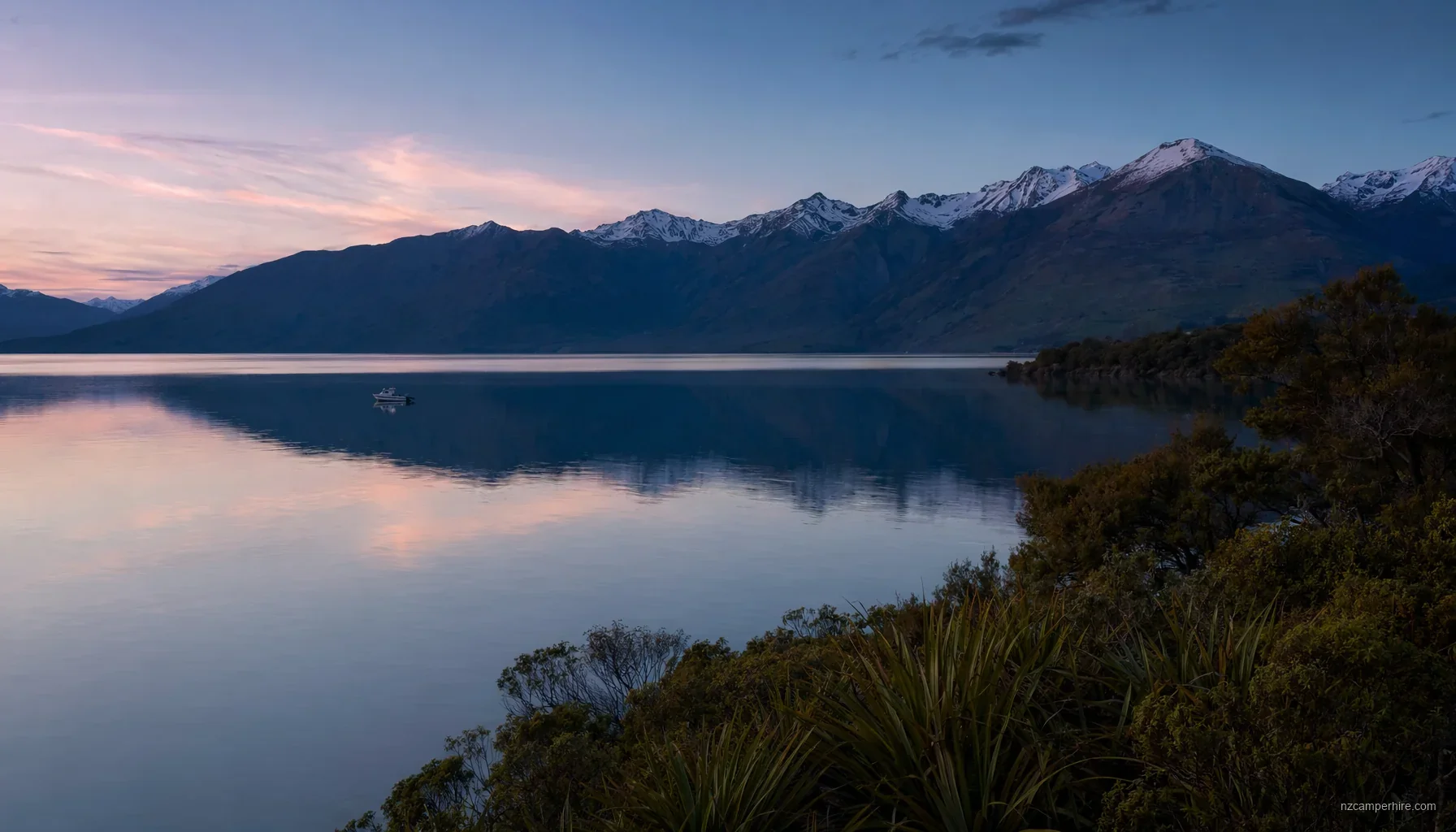
ROUTE Queenstown + Fiordland loop
Round-trip from Queenstown — Te Anau, Milford Sound, Doubtful Sound, Wanaka.
See the route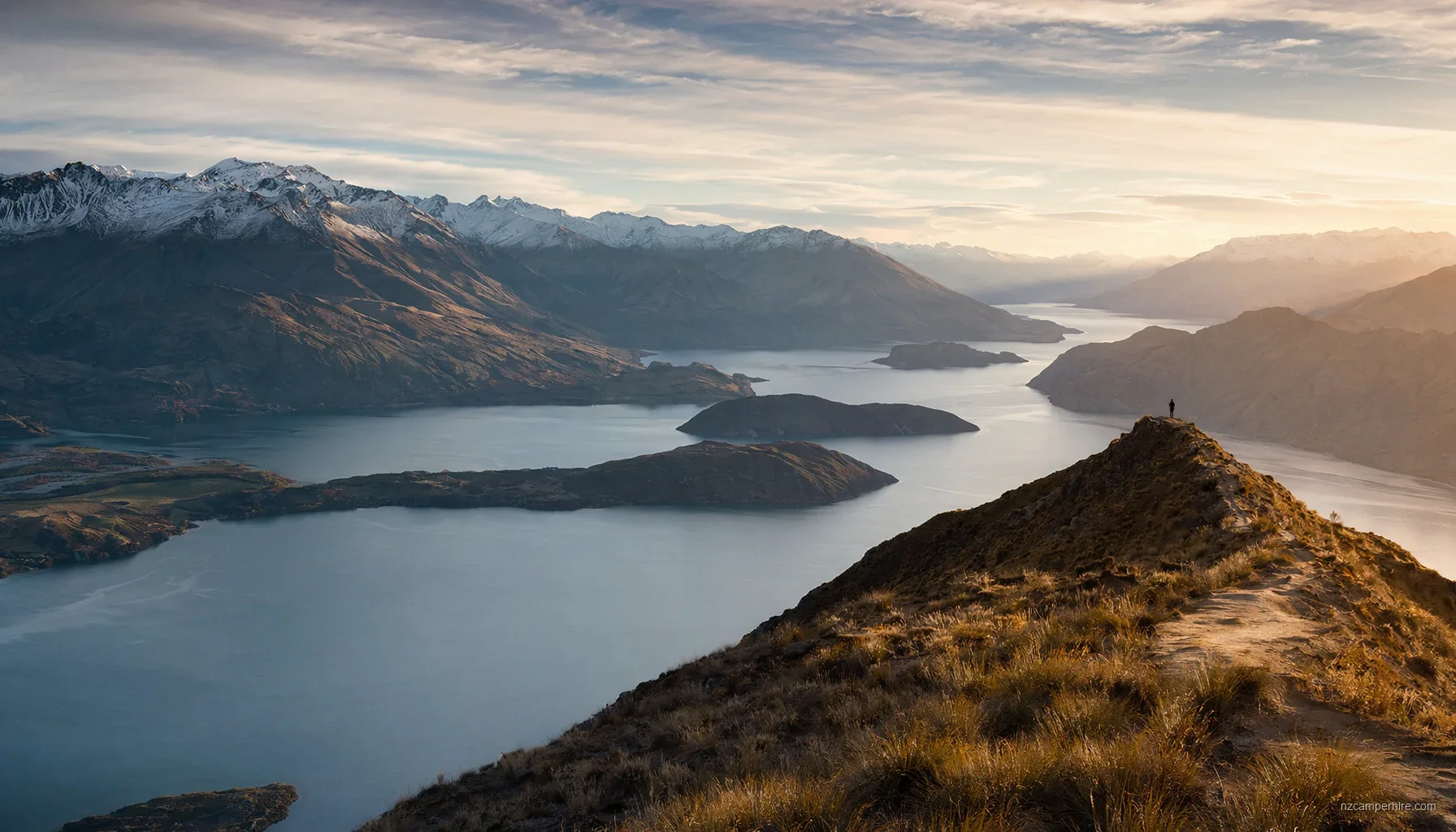 REGION
 Wanaka
Smaller, quieter alternative to Queenstown. Roy's Peak, lone tree, Mt Aspiring National Park.
See the region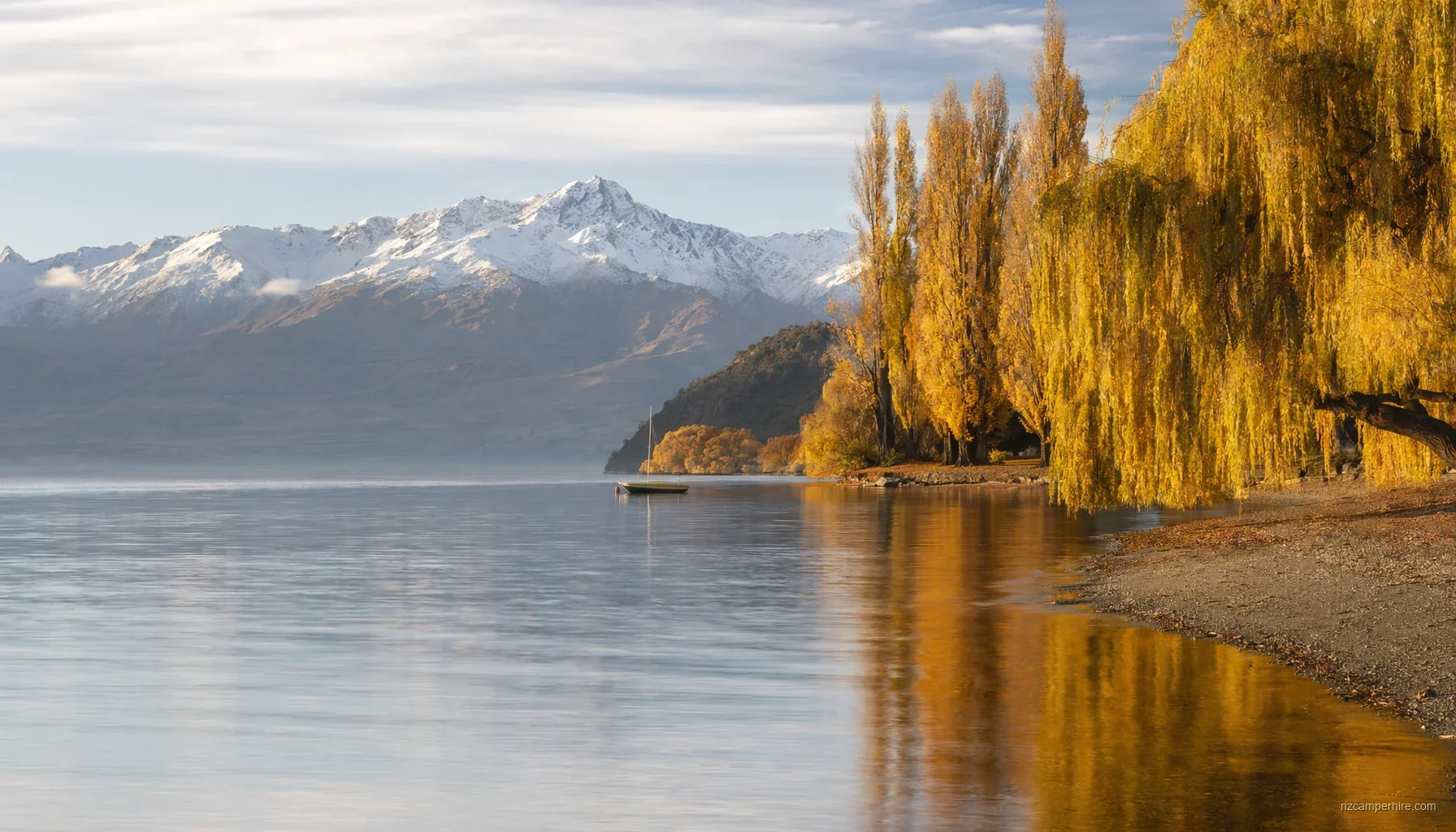 PRACTICAL GUIDE
 Shoulder seasons (March-May, September-November)
Sweet spot for many — better availability, lower rates, still good weather.
Read the guideWinter (June-August) FAQ
Do I need snow chains for a winter campervan trip?
Is winter too hard for first-time left-side drivers?
Can I freedom camp in winter if campsites are quiet?
Do holiday parks and DOC campsites stay open in June to August?
Will the campervan heater run all night?
Have a planner answer this for your specific trip
Rules and practicalities depend on dates, party size, and route. Send us your outline and we'll come back with answers tailored to your trip.