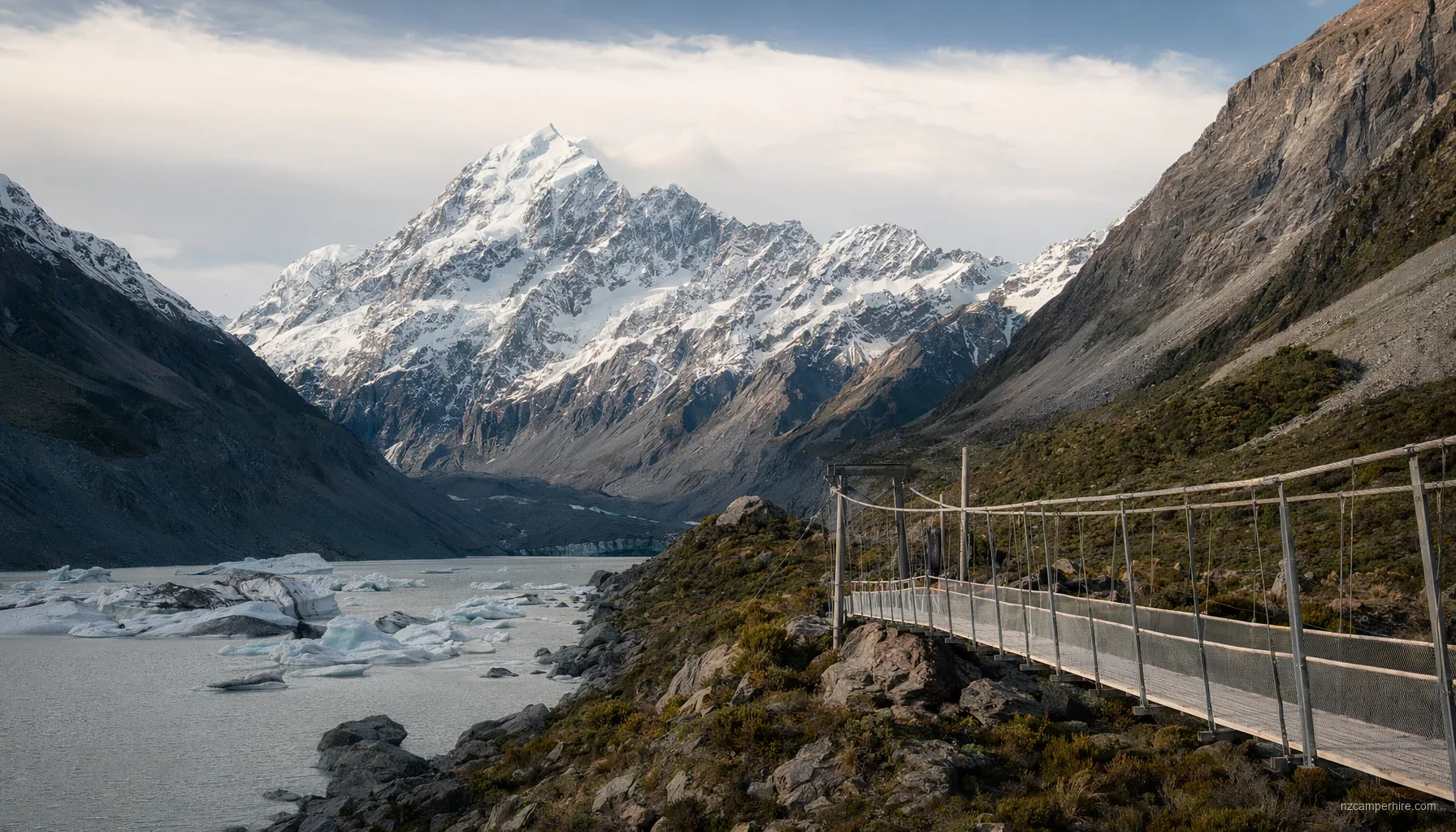
Mount Cook / Aoraki guide for motorhome travellers
South Island · destination region
- slow-morning
- bring-warm-layers
- book-ahead
- dark-sky
- kea-territory
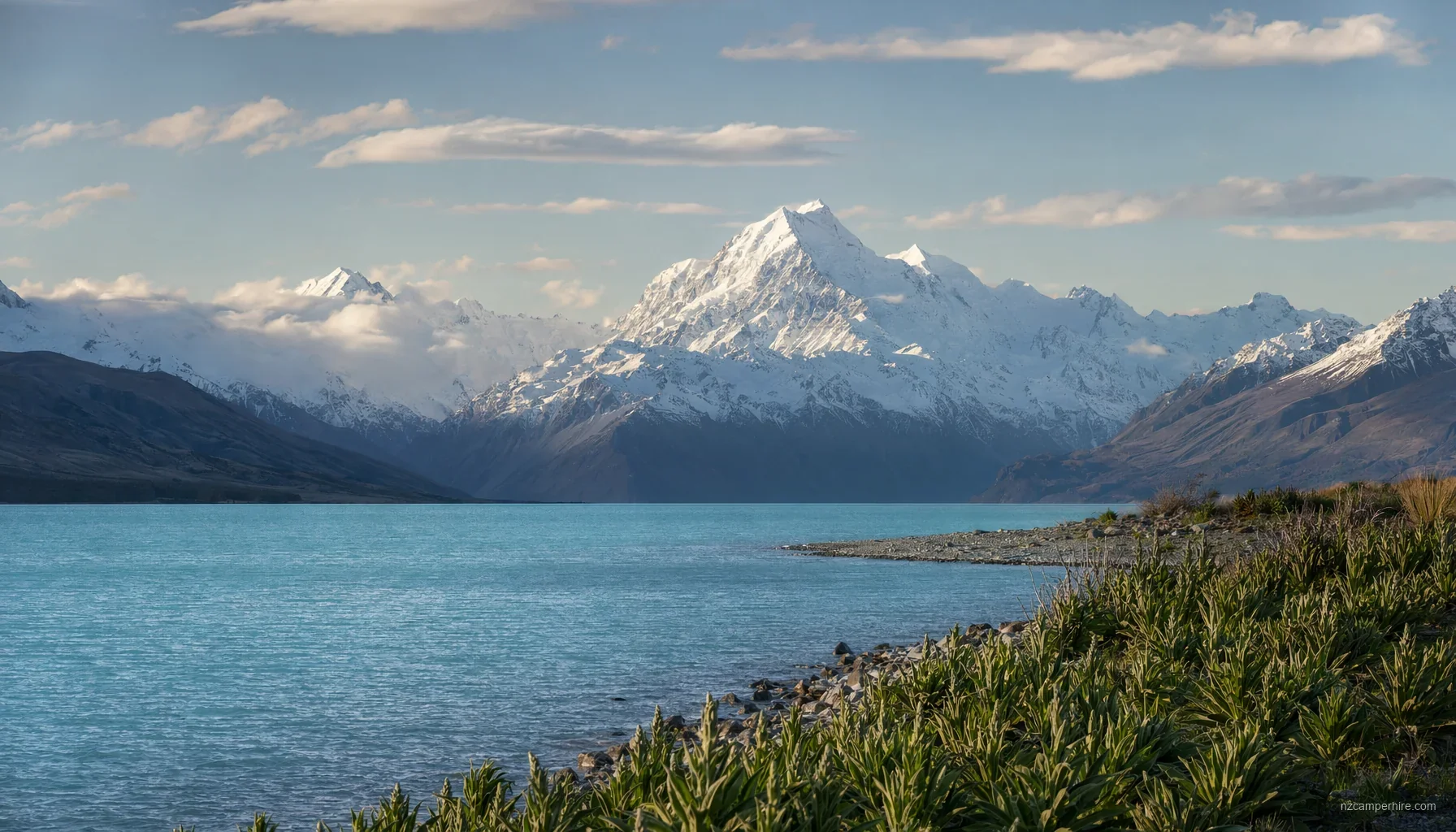
On a still morning by Lake Pukaki, the road seems to run straight towards the snow line, with the kettle cooling in the van and the peaks changing colour while you look for your socks. Mount Cook / Aoraki is not a drive-through viewpoint. It is the high alpine end of the Mackenzie Country, reached by SH80 along Lake Pukaki, with New Zealand's highest mountain above you and fast-changing weather doing what it wants.
Most first-time motorhome travellers fit it between Lake Tekapo, Wanaka, Queenstown, or Christchurch. It works beautifully in a South Island in 14 days route, and still earns its place on a tighter Christchurch to Queenstown route if you give it at least one night.
See route guides that pass through Mount Cook / Aoraki — and reply with your dates if you'd like a planner to suggest the right number of nights here.
What this region is for, in a motorhome
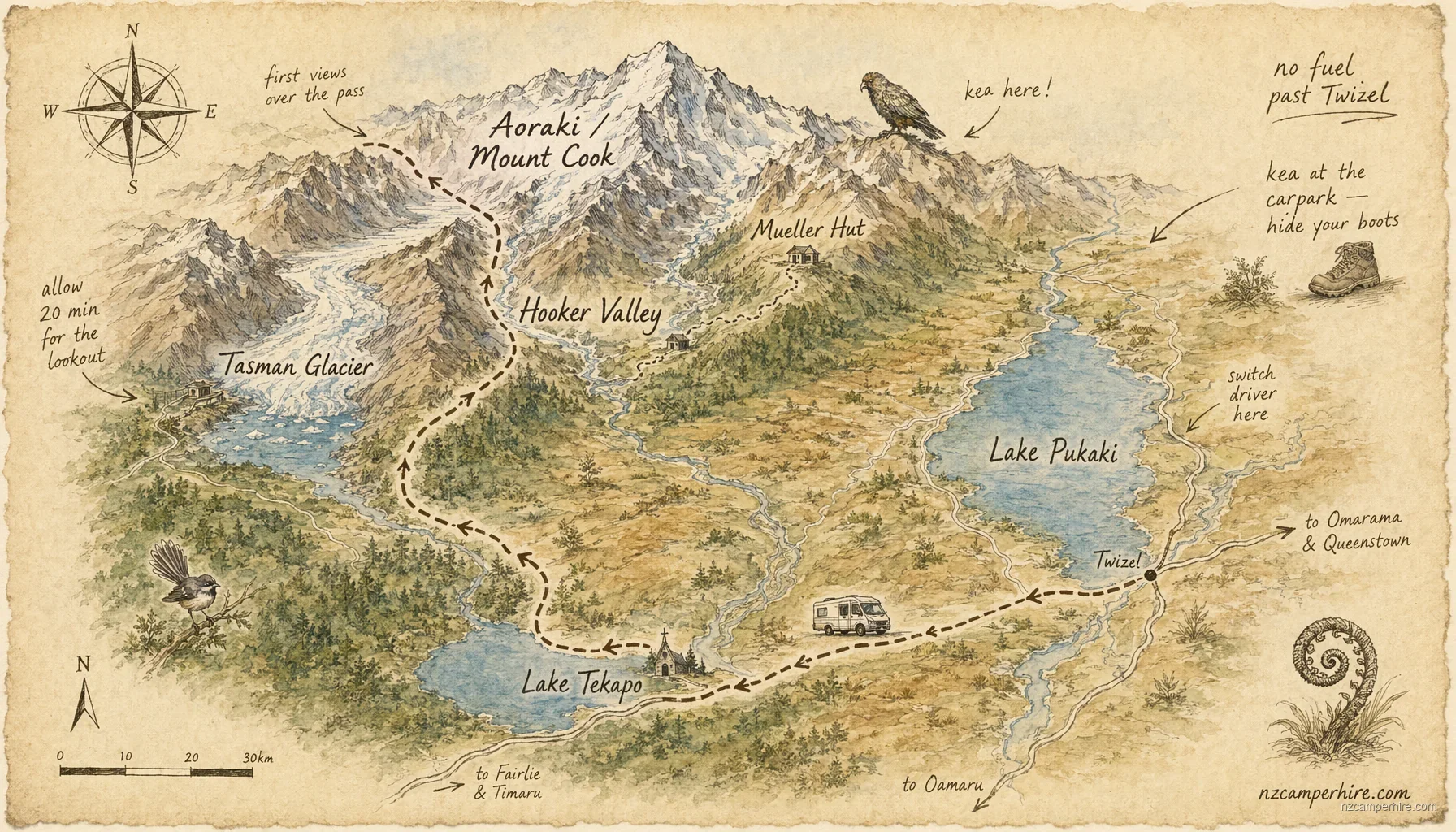
Mount Cook / Aoraki is for walking, weather watching, and slowing down. The main village is small. There is no proper supermarket, no big evening strip, and no reason to rush around ticking off ten stops. The reward is the setting: Hooker Valley, Tasman Glacier, Mueller Lake, moraine walls, and big night skies when the cloud clears.
For a first New Zealand motorhome trip, this is a strong two-night stop if your itinerary allows it. One night gives you a weather window for the Hooker Valley Track. Two nights gives you a second chance if cloud or wind closes in. Three nights suits hikers, photographers, and travellers who prefer one serious place over three shallow ones.
The recommended vehicle size here is usually a 2-berth or compact 4-berth. A 6-berth can do the roads, but it catches wind on SH80 and is slower through the Lindis Pass if you are coming from Wanaka or Queenstown. Use the vehicle-size guide if you are choosing between comfort at camp and easier alpine driving.
Driving in and out: what the road is actually like
The access road is SH80, a 55 km sealed road from the SH8 turn-off near Lake Pukaki to Aoraki/Mount Cook Village. It is one of the most scenic sealed roads in the country, but it is exposed. Crosswinds, black ice in winter, and drivers stopping suddenly for photos are the main hazards.
SH80 is beautiful but exposed, so the best photo stop is the one you can pull into safely, not the one your passenger spots at the last second.
- Christchurch to Mount Cook Village: about 330 km, allow 4.5 to 5 hours of real driving via SH1, Geraldine, Fairlie, Lake Tekapo, SH8 and SH80.
- Queenstown to Mount Cook Village: about 265 km, allow 3.75 to 4.5 hours via SH6, Cromwell, SH8 and the Lindis Pass at 965 m.
- Wanaka to Mount Cook Village: about 210 km, allow 3 to 3.5 hours via Tarras, SH8A, SH8 and SH80.
- Lake Tekapo to Mount Cook Village: about 105 km, allow 1 hour 20 minutes, longer if you stop at Lake Pukaki.
New Zealand drives on the left. If your licence is in English, it is generally valid for up to 12 months. If it is not in English, carry an International Driving Permit or an approved translation. Minimum hire age varies from 18 to 25 depending on operator and vehicle class, so check that before building a route around alpine driving days.
What to see, and what to skip
The Hooker Valley Track is the main reason most travellers come. It is about 10 km return from the White Horse Hill area, usually 3 to 4 hours with photo stops, and mostly easy underfoot. Start early in summer. By late morning in January, the car park can be busy and the wind often lifts.
The Tasman Glacier Viewpoint is shorter and steeper. Allow 45 to 60 minutes return from the Tasman Valley car park. It gives you a look over the lake, icebergs when conditions suit, and the wider glacier valley. Kea Point is another good short walk if the mountain is hiding but the lower valley is clear.
You will know you have slowed down enough when the plan is just a warm layer, a track sign, and watching the cloud decide what it wants to reveal.
Sealy Tarns is a real climb, around 2,200 steps. It is excellent in calm weather and miserable in strong wind. Do not treat it like a casual add-on after a long drive from Queenstown. Skip paid scenic extras if the cloud is low. In this region, weather is not background detail. It decides the day.
Where to stay overnight
There are not many legal overnight options close to the mountain, so plan this part properly. Freedom camping rules in the Mackenzie District are strict, and self-contained certification matters. Read the freedom camping guide before assuming a lake edge pull-off is legal.
- DOC White Horse Hill Campground: no powered sites, practical hiker and early-start vibe, about 2.5 km from Aoraki/Mount Cook Village; the Hooker Valley Track starts almost at the campground gate.
- Glentanner Park Centre: powered and non-powered sites, easy family-friendly holiday park feel, about 23 km from the village; useful for showers, laundry, and a calmer base away from the busiest trailhead.
- Lake Pukaki freedom camp area: no power, self-contained vehicles only, better for independent adults than families needing facilities, about 45 to 55 km from the village depending on the signed area; the draw is legal lake-edge camping when the rules and space allow it.
- DOC Lake Poaka Campsite: no power, simple low-key DOC setting, about 55 to 60 km from the village near Twizel; a useful overflow option if you want basic facilities and a quieter night.
- Twizel Holiday Park: powered and non-powered sites, family-friendly and practical, about 65 km from the village; best for supermarket access, fuel, dump station planning, and an early run up SH80 the next morning.
- Lake Tekapo Motels & Holiday Park: powered sites available, busy family holiday park feel in peak season, about 105 km from the village; works when you are linking Mount Cook with the Lake Tekapo region and want services before or after the alpine road.
Best time of year for Mount Cook / Aoraki
December to March is the easiest season for most motorhome travellers. Roads are usually clear, daylight is long, and the Hooker Valley Track is straightforward in normal conditions. January is the peak month. If you need a powered site in January, sort that part early rather than hoping the mountain village area will absorb late arrivals.
April is one of the best shoulder-season months. Cooler mornings, less pressure on campsites, and often clear air across the Mackenzie Basin. May to September can be beautiful, but you need to think about frost, ice, snow chains if instructed, and shorter daylight. SH80 is sealed, but winter driving is still winter driving.
November brings spring snow on the peaks and changeable weather in the valleys. It is a good month if you are flexible. Build Mount Cook into a when-to-go month guide alongside Wanaka, Queenstown, and the West Coast, because the best month for one part of the South Island is not always the best month for all of it.
Practical notes
Fuel before you drive SH80. Twizel and Lake Tekapo are the reliable planning points. Do not arrive at Mount Cook Village expecting normal town services. Food is the same story. Stock the motorhome at Four Square Twizel, Four Square Lake Tekapo, or a larger supermarket earlier in Christchurch, Timaru, Wanaka, or Queenstown.
Mobile coverage is generally usable around the village and main road, but it can fade in valleys and around camp areas. Download maps before leaving SH8. Weather forecasts matter here, but so does looking out the window. If the wind is already strong at Lake Pukaki, expect a slower drive up SH80.
Dump tanks before the alpine section if you can. Twizel and Lake Tekapo have public dump station options, while holiday parks usually provide facilities for guests. There is no need to carry full grey water into White Horse Hill if you can avoid it. This is exactly the sort of practical detail our cost article and vehicle-size guide cover, because larger vans carry more comfort but also need more service planning.
Common first-trip mistakes here
The first mistake is making Mount Cook a lunch stop between Christchurch and Queenstown. That turns a mountain region into a car park visit. If your route is tight, stay one night. If your route has room, stay two.
The second mistake is chasing clear-sky photos on a fixed hour. Cloud can sit on Aoraki while the lower valley is still worth walking. Do Hooker Valley, Kea Point, or Tasman Glacier Viewpoint according to conditions, not according to a rigid list.
The third mistake is assuming every lakefront space is legal for the night. Mackenzie District rules are enforced, and signs matter. Certified self-contained vehicles have more options, but not unlimited rights. If you are unsure, use a named campground or holiday park and keep the trip simple.
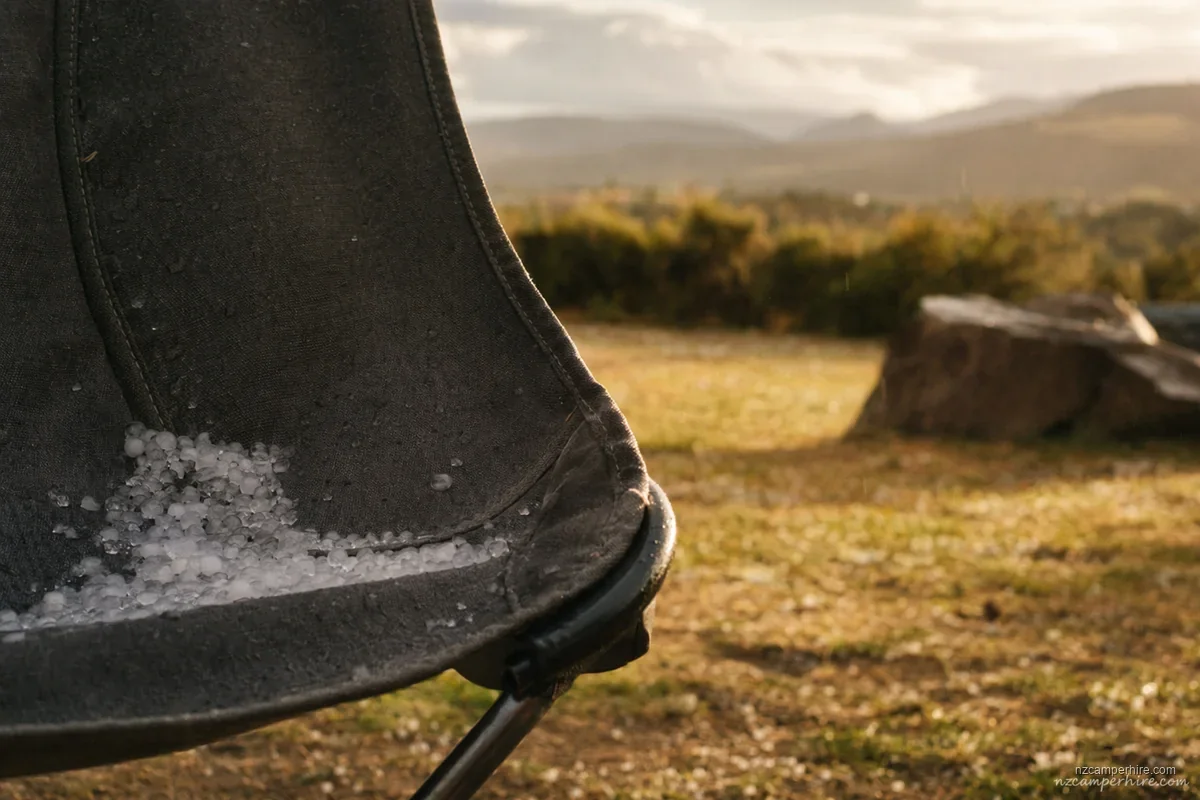
Mount Cook / Aoraki rewards travellers who linger. Build in one slow morning — coffee on the camp table, the kettle whistling, the day not yet decided.
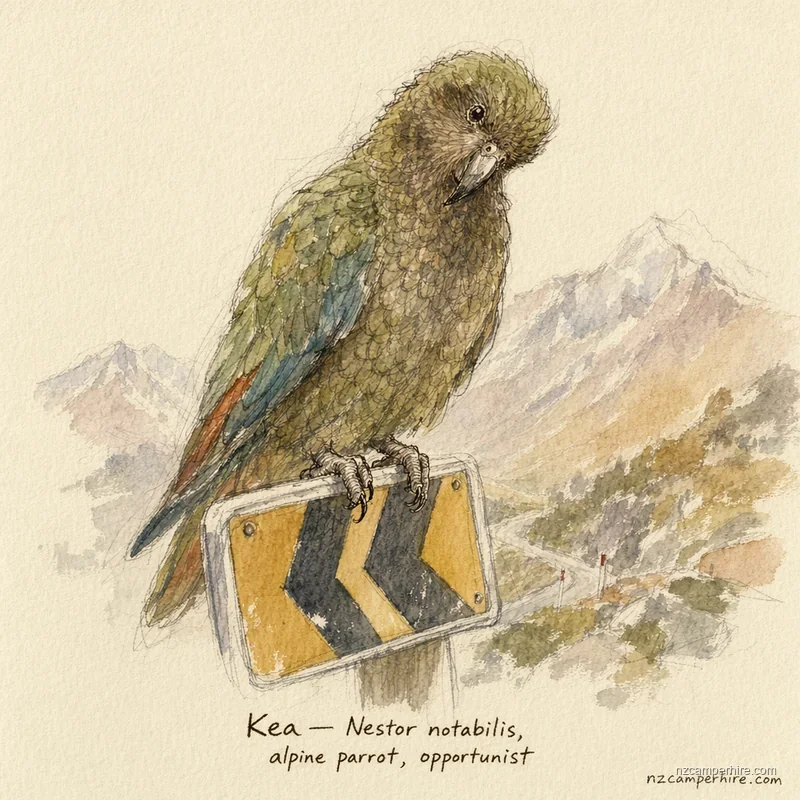
Aoraki — known internationally as Mount Cook / Aoraki
Aoraki is the most sacred mountain in Ngāi Tahu cosmology. The pūrākau tells that Aoraki and his three brothers came down from the sky in a waka (canoe), the canoe ran aground and was turned to stone — becoming Te Waka-a-Māui (the South Island) — and the brothers themselves were turned to stone, becoming the Southern Alps. Aoraki, the eldest, is the highest peak. The Ngāi Tahu Claims Settlement of 1998 returned the title of the mountain to Ngāi Tahu, who immediately gifted it back to the nation — the official name is now Aoraki / Mount Cook.
The Tasman Glacier is Haupapa. The Hooker Valley track follows the Hooker River (Te Awa Whakatipu).
- Aoraki / Mount Cook Visitor Centre (DOC) — Tells the story of the gift-back and Ngāi Tahu co-management. Public, free.
- Hooker Valley Track — Three-hour return walk to the terminal lake of the Hooker Glacier — bilingual interpretive panels along the route.
Aoraki Routes acknowledges the mana whenua of Ngāi Tahu. We recommend visiting cultural sites with respect and following the tikanga (protocol) of the host iwi.
Related reading
 ROUTE
ROUTE South Island in 14 days
Classic clockwise South Island loop — Kaikoura, Nelson, West Coast glaciers, Wanaka, Queenstown, Milford Sound, Tekapo, back to Christchurch.
See the route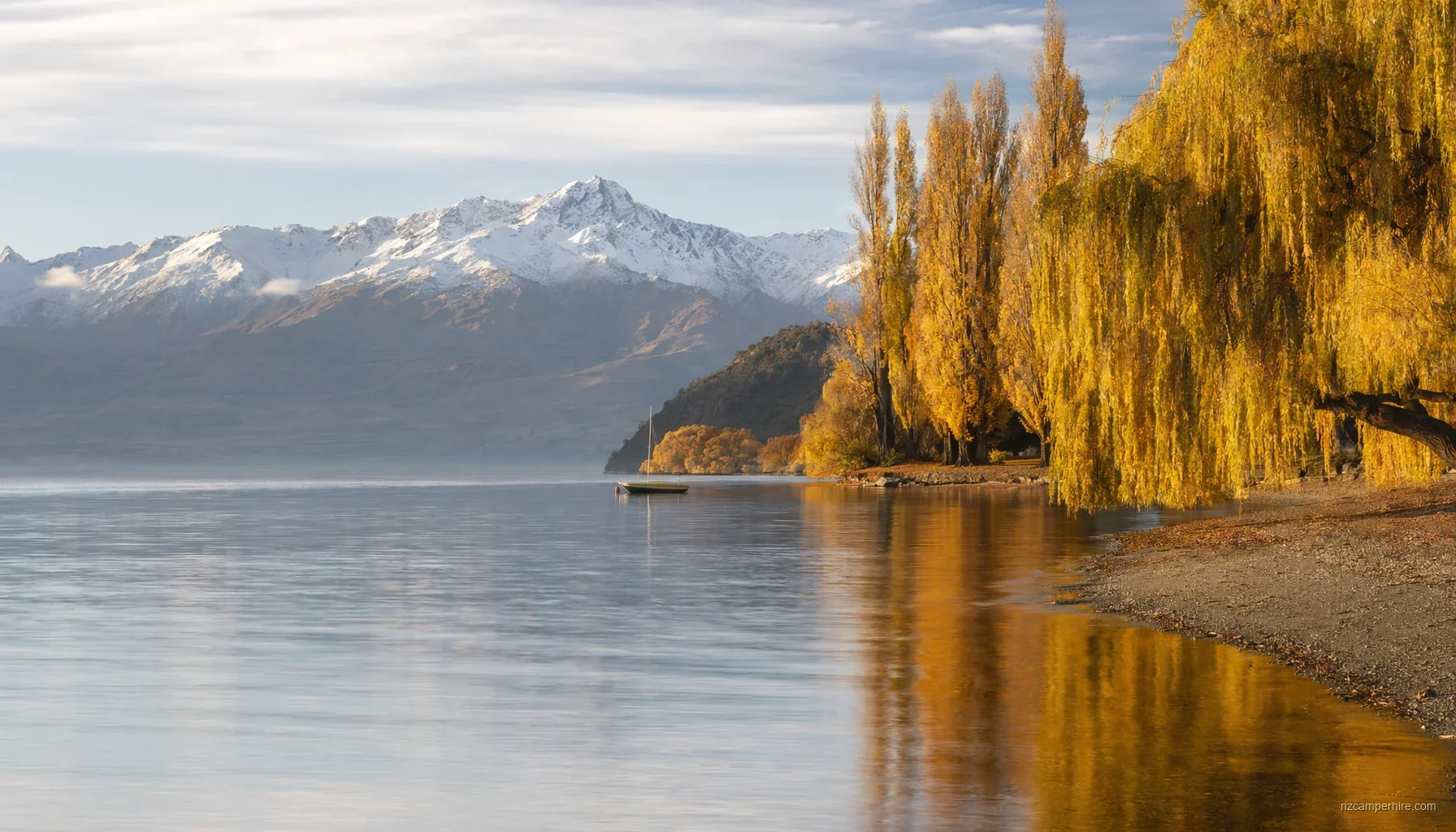 WHEN TO GO
 Shoulder seasons (March-May, September-November)
Sweet spot for many — better availability, lower rates, still good weather.
Read the timing notes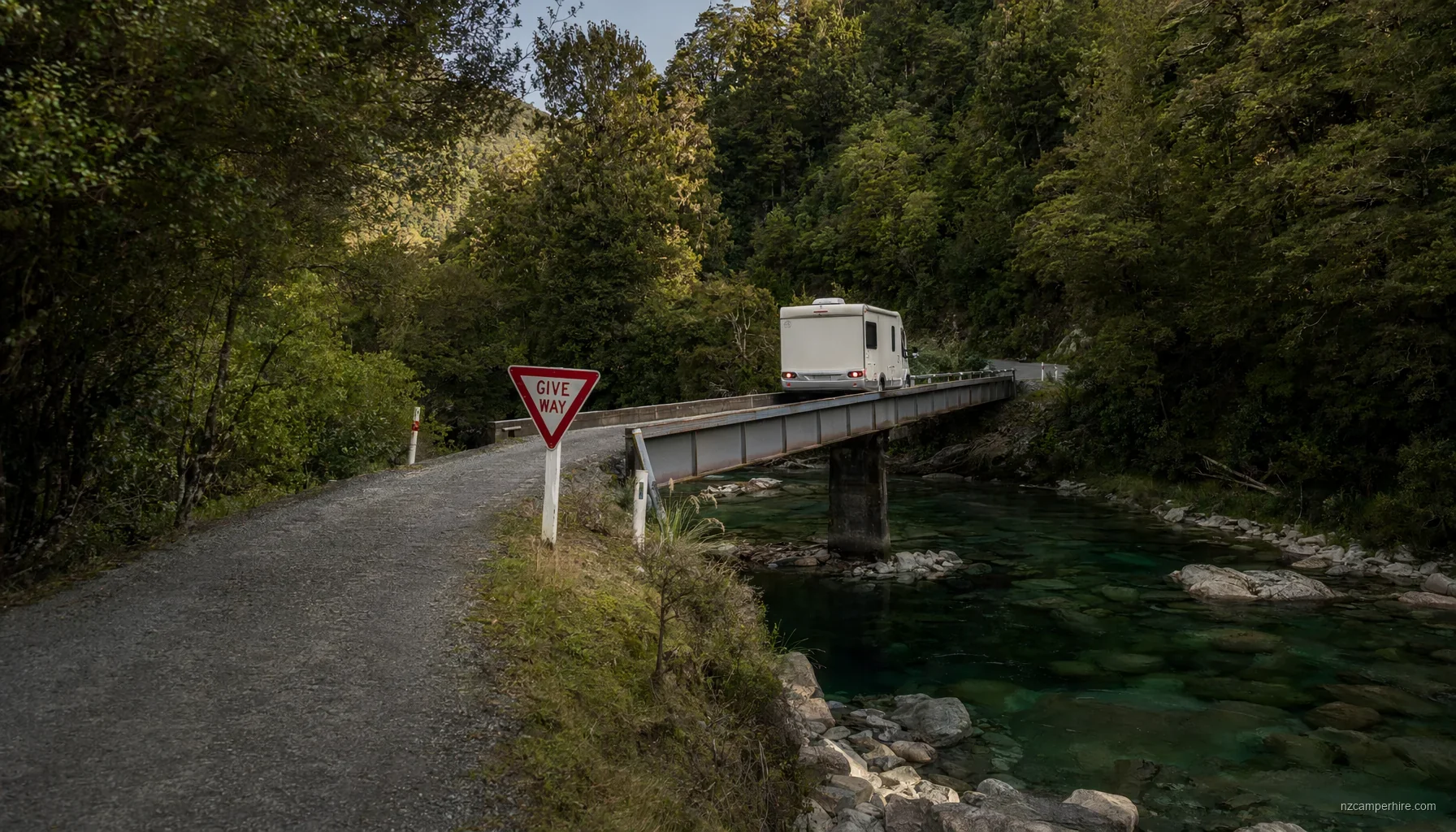 PRACTICAL GUIDE
 First time driving a motorhome
Height awareness, swing on turns, parking, reversing — short briefing before pickup.
Read the guideMount Cook / Aoraki FAQ
How long should I stay at Mount Cook / Aoraki in a motorhome?
What is the best month to visit Mount Cook / Aoraki?
Where is the nearest supermarket to Mount Cook Village?
Where can I dump grey water and toilet waste near Mount Cook?
Have a planner shape a trip around this region
Tell us roughly when you're coming and how long you have. We'll come back with a route that gives this region the time it deserves.