Rotorua motorhome guide: hot pools, lakes and stays
North Island · destination region
- slow-morning
- wet-weather-plan
- family-friendly
- busy-summer
- hot-pools-nearby
On a cool morning, Rotorua announces itself quietly: a pale ribbon of steam over the drain grates, the lake still grey, someone’s camp kettle clicking on before the first tour bus rolls past.
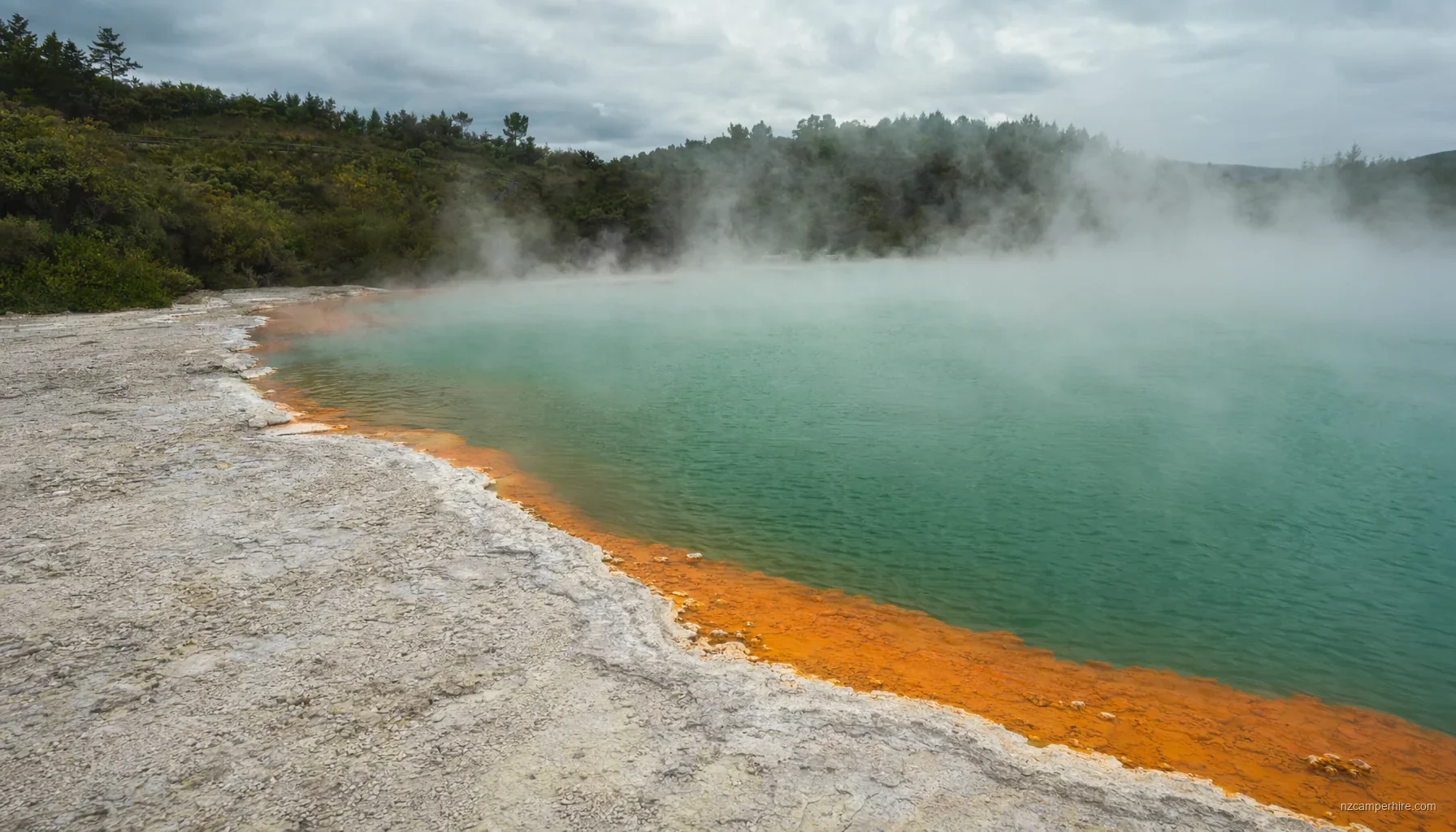
Rotorua is the North Island’s geothermal base. Steam rises beside footpaths, lake roads lead to swimming spots, and the better cultural and geothermal stops need time rather than a rushed hour between long drives.
Most first trips reach Rotorua from Auckland, the Coromandel, Taupō, or Tongariro. Auckland to Rotorua is about 230 km and usually 3 to 3.5 hours in a motorhome, not the neat 2.5 hours you may see quoted for a car in light traffic.
See route guides that pass through Rotorua — and reply with your dates if you'd like a planner to suggest the right number of nights here.
What this region is for, in a motorhome
Rotorua works best as a two-night stop on a North Island in 10 days route, or as the warm-up point for a Rotorua + Tongariro loop. It is not just one attraction. The value is in having a parked base, short drives, and time to soak, walk, and sort laundry before the next longer leg.
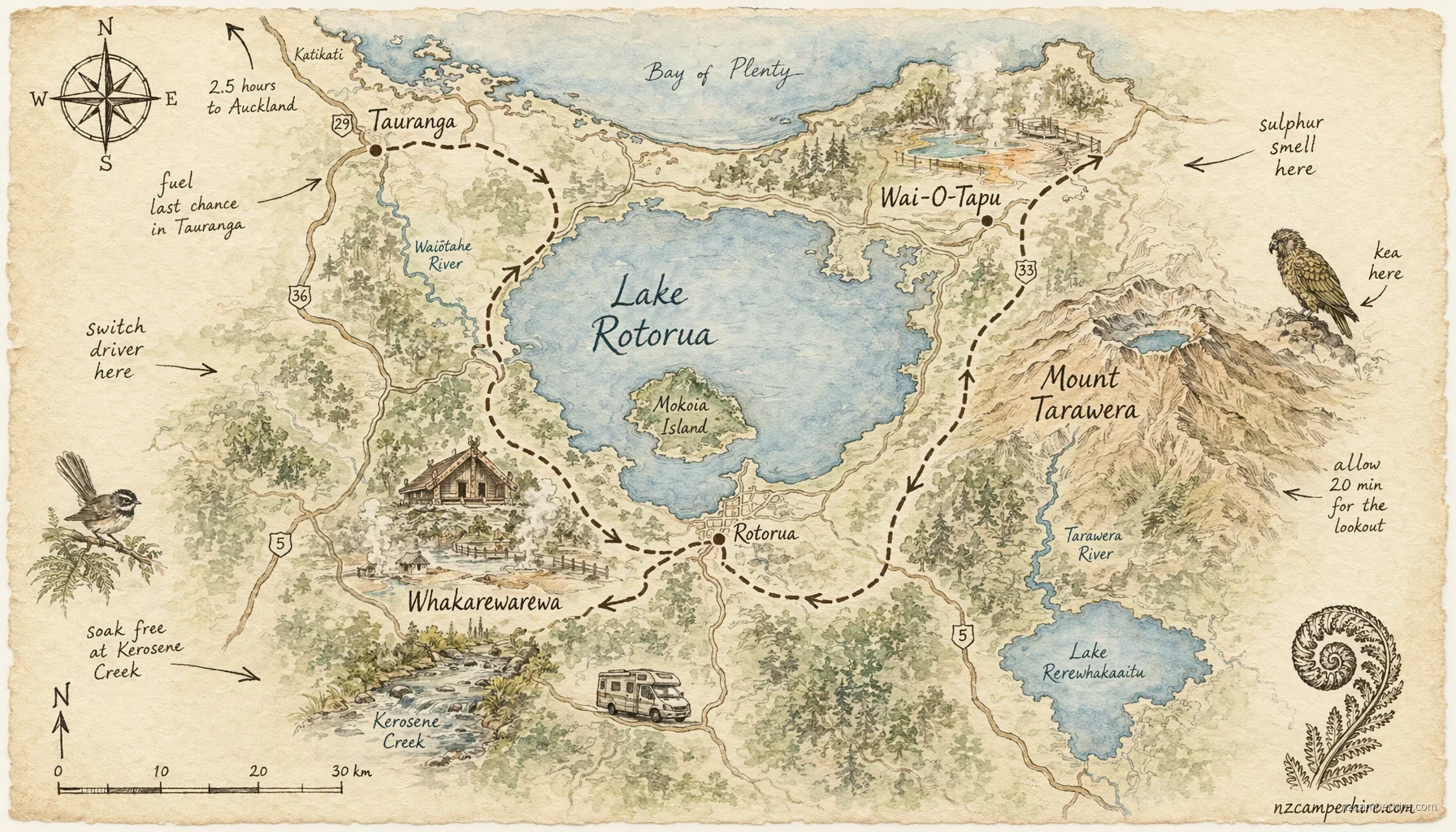
The town sits around 280 m above sea level, with Lake Rotorua on one side and forest, smaller lakes, and thermal valleys on the other. Distances are kind to motorhome travellers. The Redwoods at Whakarewarewa Forest are 5 km from town. Blue Lake, properly Lake Tikitapu, is about 10 km and 15 minutes away. Wai-O-Tapu is 30 km south on SH5, usually 30 to 35 minutes in a van.
For most first-time visitors, the recommended vehicle size here is a 2-berth or compact 4-berth. A 6-berth is manageable on the main roads, but it is clumsy in the tighter lake car parks, supermarket bays, and busy thermal attraction parking areas. The vehicle-size guide is worth reading before you build a North Island route around town centres and lake roads.
What to see, and what to skip
Pick one paid geothermal area properly rather than trying to tick off three. Te Puia is close to town and suits travellers who want geysers, Māori arts, and a cultural visit in one place. Wai-O-Tapu, south of town, is more about coloured pools and a wider geothermal landscape. Waimangu Volcanic Valley is quieter and better if you like a longer walk.
The tradeoff is simple: the paid parks are worthwhile, but entrance fees add up quickly if you try to do them all, so choose one and give it proper time.
For free or low-cost time, the Redwoods are the easy win. Park once, walk 30 to 90 minutes, and avoid moving the van between small attractions. Kuirau Park is also useful because it is close to the centre and gives you steaming ground without a long detour.
Skip overfilling the day with every lake. Blue Lake is easy, Lake Ōkareka is prettier and quieter, and Lake Tarawera is worth the drive if the weather is clear. If rain is heavy, use Rotorua as a hot-pool and food stop rather than forcing scenic lake driving for no view.
Where to stay overnight
Rotorua has practical holiday parks close to town and a few simpler lake options further out. Freedom camping rules are tighter than many visitors expect. You need a certified self-contained vehicle for places where it is allowed, and local signs override anything you read in an old forum post.
- Rotorua Thermal Holiday Park: powered and unpowered sites, family-friendly, about 3 km south of the town centre. The draw is on-site mineral pools and quick access to Te Puia and the forest side of town.
- Rotorua Top 10 Holiday Park: powered and unpowered sites, easy for families and first-night travellers, about 1 km from Eat Streat and the lakefront. Good if you want to park the van and walk into town for dinner.
- Blue Lake Top 10 Holiday Park: powered and unpowered sites, outdoorsy family feel, about 10 km or 15 minutes from central Rotorua. The draw is swimming and walking at Lake Tikitapu without driving back after sunset.
- Holdens Bay Holiday Park: powered and unpowered sites, quieter suburban feel, about 8 km east of town near the airport side of Lake Rotorua. Useful if you are arriving from Tauranga or the Bay of Plenty.
- Ash Pit Road Campsite: DOC, no power, simple lakeside camping at Lake Rerewhakaaitu, about 33 km south-east of Rotorua. Best for self-sufficient travellers who want a quieter night and do not need town facilities.
Driving in and out — what the road is actually like
From Auckland, the usual run is SH1 south, then SH27 and SH5 through Matamata and Tirau, or a variation through Hamilton. Allow 3 to 3.5 hours from central Auckland to Rotorua in a motorhome, plus food and fuel stops. Hobbiton is near Matamata, not in Rotorua, so treat it as a stop on the way rather than a town activity.
Rotorua to Taupō is 80 km on SH5 and normally takes 1 hour to 1 hour 15 minutes. The road is good but carries trucks, tourist traffic, and impatient overtakers. Rotorua to Tongariro National Park is about 175 to 190 km depending on your village stop, and usually 2.5 to 3 hours via Taupō and SH1.
To Tauranga, SH36 is only about 65 km, but the road is hilly and bendy in places. Allow 1 hour 10 minutes, more in rain. NZ drives on the left. If your licence is in English it is valid for up to 12 months as a visitor; if it is not in English, bring an International Driving Permit or approved translation. Minimum hire age varies from 18 to 25 depending on operator and vehicle class.
Best time of year for Rotorua
January is the peak month. It is warm, school holidays are in full swing, and the lake camps fill first. If you are travelling then, plan Rotorua nights early and avoid arriving late on a Friday with no overnight plan.
November, early December, February, March, and April are easier months. Days are usually warm enough for lake time, but the town is less pressured. Winter is not a bad choice either. Steam looks better in cold air, hot pools make more sense, and Rotorua rarely gets the hard alpine weather you need to consider around Tongariro.
Rotorua feels especially right when the morning air is cold enough to show the steam, and the first brave lake swimmer is still negotiating with their towel.
For a wider timing check, use the when-to-go guide alongside the North Island in 7 days and North Island in 10 days route guides. Rotorua can be good year-round, but the roads and overnight pressure around it change a lot between July, October, and January.
Practical notes
Fuel is easy in Rotorua, with large stations on the main approaches and around the central area. Supermarkets are also straightforward: PAK'nSAVE Rotorua on Amohau Street is useful for a bigger shop, and Woolworths and New World options cover top-ups. Stock up here before heading to Tongariro or smaller lake camps.
Mobile coverage is good in town and around the main attractions. It becomes patchier near some lake edges and forest roads. Download your map before driving out to Lake Tarawera, Lake Rerewhakaaitu, or the back roads toward Waikite Valley.
Dump stations are commonly available at holiday parks for guests, including Rotorua Thermal Holiday Park, Rotorua Top 10, and Blue Lake Top 10. If you are using a DOC or low-facility camp, check the current council or camping app listing before you leave town. The freedom camping guide is important here because Rotorua Lakes rules are location-specific and enforcement is real.
Common first-trip mistakes here
The first mistake is treating Rotorua as a quick lunch stop between Auckland and Taupō. You can do that, but you will mostly see traffic lights and car parks. One night is better. Two nights is the normal useful stay.
The second mistake is leaving valuables visible while parked at busy lake or forest car parks. Use normal city habits. Put passports, electronics, and camera bags out of sight before you arrive, not after people see you packing them away.
The third mistake is underestimating sulphur smell and steam near thermal ground. Stay on marked paths. The crust can be thin, and warning signs are there for burns, not decoration. If you are travelling with children, Rotorua is excellent, but it is not a place to let them wander ahead near hot ground.
Rotorua rewards travellers who linger. Build in one slow morning — coffee on the camp table, the kettle whistling, the day not yet decided.
Te Rotorua-nui-a-Kahumatamomoe — known internationally as Rotorua
Te Arawa is the iwi confederation descended from the Te Arawa waka (canoe) that arrived from Hawaiki around 1350 CE. The Rotorua lakes and the geothermal field have been Te Arawa's home and economic base for nearly 700 years. The geothermal cultural tourism that defines Rotorua today began in the 1870s and has always been Māori-led.
Whakarewarewa is short for Te Whakarewarewatanga-o-te-ope-a-Wāhiao — 'the gathering place of the war party of Wāhiao'. Almost every geyser, hot pool, and mud pot has a te reo name with a specific story.
- Te Puia — Geothermal valley plus Te Wānanga Whakairo (the national carving school) and Te Rito (the national weaving school). Pōhutu geyser erupts on site. Public ticketed.
- Whakarewarewa — The Living Māori Village — A village where Tūhourangi-Ngāti Wāhiao families still live among the geothermal features. Paid guided visit only — please don't wander off the marked path.
- Ōhinemutu — Lakeside Māori village beside central Rotorua, with Tama-te-kapua meeting house (closed to the public) and St Faith's Anglican Church (open). Walk through respectfully — this is a residential village, not a tourist site.
Aoraki Routes acknowledges the mana whenua of Te Arawa, Ngāti Whakaue and Tūhourangi-Ngāti Wāhiao. We recommend visiting cultural sites with respect and following the tikanga (protocol) of the host iwi.
Related reading
 ROUTE
ROUTE Rotorua + Tongariro loop
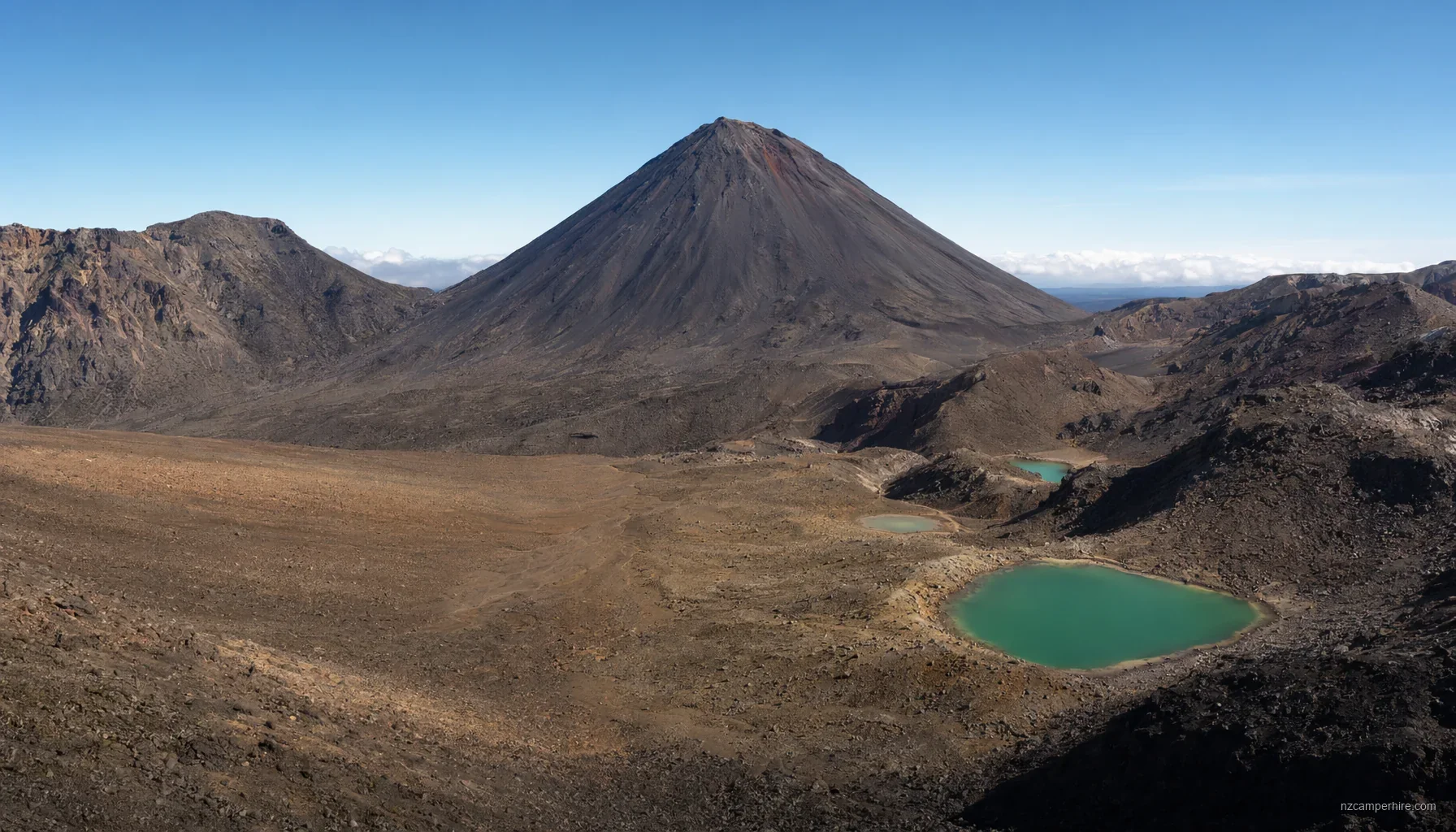
Volcanic plateau loop — Hobbiton, Rotorua geothermal, Tongariro Alpine Crossing.
See the route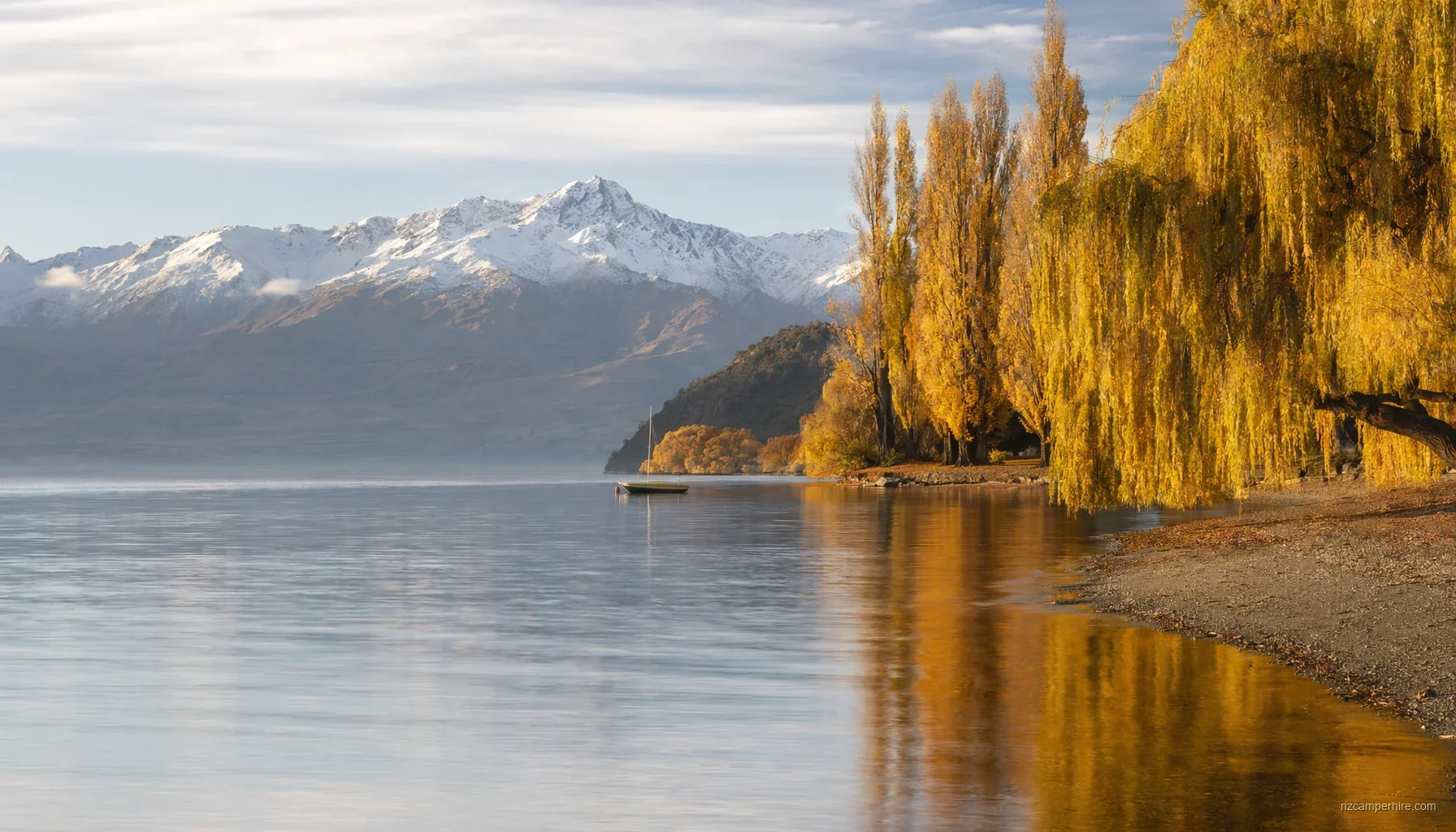 WHEN TO GO
 Shoulder seasons (March-May, September-November)
Sweet spot for many — better availability, lower rates, still good weather.
Read the timing notes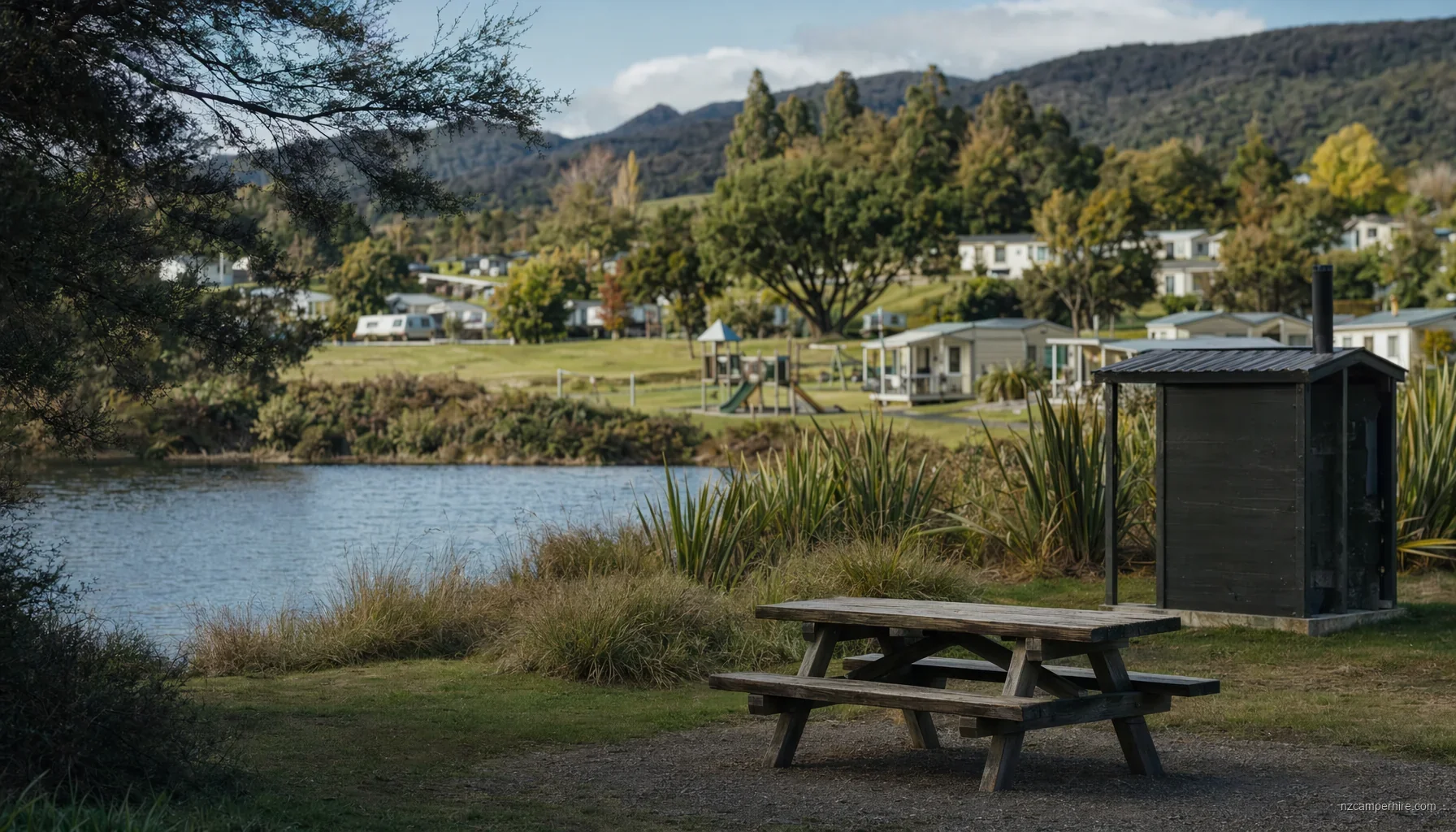 PRACTICAL GUIDE
 Holiday parks vs DOC campsites
Powered vs unpowered, facilities, booking, costs, and when each makes sense.
Read the guideRotorua FAQ
How long should we stay in Rotorua by motorhome?
When is the best month to visit Rotorua?
Where should we buy groceries in Rotorua?
Where can we dump grey water and toilet waste in Rotorua?
Have a planner shape a trip around this region
Tell us roughly when you're coming and how long you have. We'll come back with a route that gives this region the time it deserves.